The History of Belchamp Walter
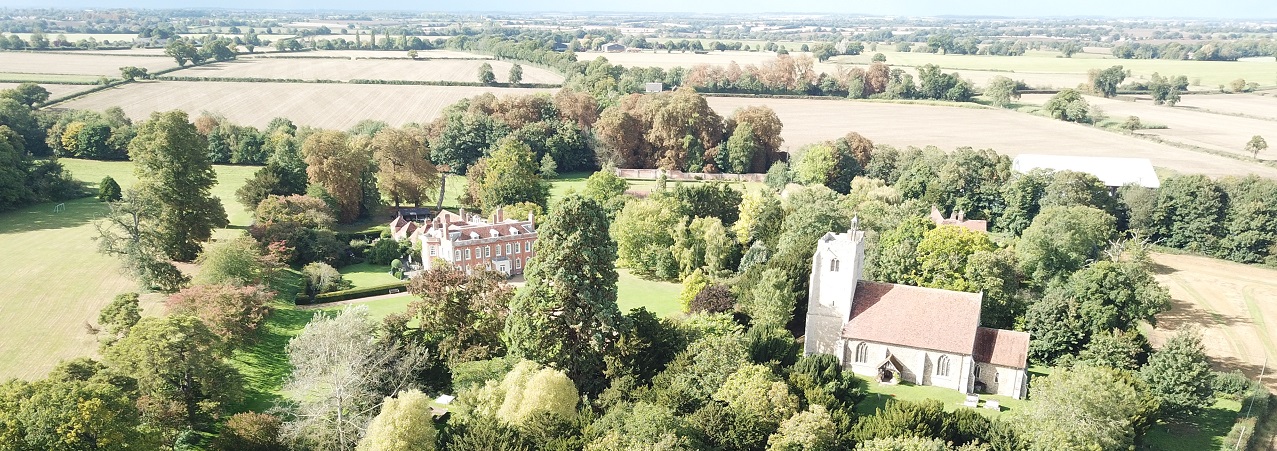
This is Martin's History of the village of Belchamp Walter. It is an attempt to put things in perspective to what was going on in the country throughout the history of the Village. The village and the church are featured on their own pages.
A synopsis of the History of Belchamp Walter.
The settlement of Belchamp Walter (Walter Belchamp) was recorded in the Doomsday Survey, William the Conqueror's massive stock-take of his new lands.
From 1066 to the present time some is known about the village particularly after the Raymond family purchasing the Manor in 1611.
Prior to that time, in the years between Conquest and the 17th Century, the information is, like a lot of British history a little sketchy.
Before the Norman Conquest, in the years of Edward the Confessor (1042 - 1066), the settlement was under Saxon control.
After the Conquest William either allowed Ulfwine, Ulwine or Ulwin, a Saxon noble to remain as lord of the manor or he assigned it to one of his compatriots that assisted him at the Battle of Hastings. This could have been a member of the Malet Family, William Malet was reported by William of Poitiers as a companion..
The manor was then assigned to the de Veres. Alberic de Vere was related to William the Conqueror but is not found in any records of the Conquest.
This
Alberic de Vere was Sheriff of Berkshire, chamberlain to William I and resident of Earls Colne was in control of the region.
Robert Malet was possibly the first to "hold" Thunderlow but possibly had
it confiscated as he "took-up" with Robert Curthose, William's oldest son.
The 16th Century manor house was replaced by the current Belchamp Hall in 1720/1721 by John Raymond III. The manor house was probably built prior to when it "came to" John Wentworth in 1539 and was probably of Vernacular architectural design. A few other such structures still exist in the village.
The references used for this history
These are many and are listed below:
- The church guides - scanned PDFs of the original 1965 and the 2000/2014 versions are uploaded to this website
- Thomas Wright's History and Topography of Essex, 1831/36 - this was used as the basis of the history of Belchamp Walter as seen in the Georgian era.
- Many Inquistitions Post Mortem (IPMs) found by searching on-line
- Historic England - the listings for the Listed Buildings in the village
- British History Online - sadly now with many advertisements
- Domesday
- Various historians and geneologists
- Medieval - Orderic Vitalis, William of Poitiers
- "Philipots". Villare Cantianum - Thomas Philipot 1600's - I have text file of Villare Cantianum
- Morant 1700's - History and Antiquities of Essex
- J. H. F. Brabner - The Comprehensive Gazetteer of England and Wales, 1894-5 - transcribed by UKGA
- 18th Century - Edward Hasted
- 19th Century
- Sir Bernard Burke 1864 Royal Descents and Pedigrees of Founders' Kin
- The Marquis of Ruvigny and Raineval 1890's 1900 The Plantagenet Roll of the Blood Royal
- The Complete Peerage - George Edward Cockayne (1887) not thepeerage.com
- Georgian - Thomas Wright 1831/36
- Victorian - The Battle Abbey Roll - The Duchess of Cleveland's work of 1889
- Contemporary sources - The Internet Archive - Worley's 1915 guide to Essex - Douglas Richardson - The Peerage.com (NZ) - and Wikipedia
- Arnold Toynbee - b.1889 - A Study of History - published from 1934 to 1961
- The Manors of Suffolk - W. A. Copinger, M.A., LL.D., F.S.A., F.R.S.A. - 1095 = Only first of six (the following five don't seem to exist)
- The Alan Freer family tree of Descendants of William the Conqueror
- Information sheets found in various churches in the region
- Other History Books collected over the years
- Wikipedia - often a good starting point but should be clearly shown as being quoted - as such my "snips" may not be what the current Wikipedia page says.
- Maurice Beresford - the lost villages of Beauchamp St. Ethelbert and Northwood
- Maurice Boddy - Sadly his website is no longer maintained
- Kelly's Directory - I have full copies of 1882, 1894, 1902 and 1914
- Essex Archive - this is a list of what I would like to look at
- The Foundation for Medieval Geneology - FMG
- The Prosopography of Anglo-Saxon England - PASE
Geneological data was found on the many websites that have sprung up to service the ever popular quest for individuals to research their families. I admit I have a problem with this as there seems to be a proliferation of mis-information to be found on such sites. I started my research in this area from the Alan Freer family tree of William the Conqueror. The name of the current owner of Belchamp Hall can be found on Alan's tree if you make an Internet search.
There is a current (2023) guide to the church with coloured photographs, it is availble for purchase in the Church.
When enquiring what the source/reference was for the accounts found in the church I was told that nobody knew. This is why I presented (PDFs and direct quotes) all of the accounts "as is", and left to the visitor to determine what the correct facts are. I have now ascertained who the author of the church guides was.
These accounts also relate to information on the village of Belchamp Walter itself.