Belchamp Walter in the 19th Century
The 19th century in Belchamp Walter is not easy to unpick. It is too easy to just make a list of dates and events but the reasons behind the events and their context is a little more complex to understand.
On the surface it would appear that everything is just a progression of owners of Belchamp Hall and their fortunes and interactions with the community and the church. The reality is that things were far less than straight forward and the notion that the Hall and the residents of the Hall were just benefactors for the village is not actually the case. The estate was not even owned and administered by the Raymond family until 1865.
I have found many newspaper articles on events in the local area. This is probably just scratching the surface as I have just searched for names that I have found in other documents. The search for "Belchamp Walter" is an obvious search.
Most of the recorded accounts of Belchamp Walter and the families who lived there in the nineteenth century are dated from the middle of the century. Belchamp Walter was largely an agricultural community and the residents were occupied in farm and farm related activities. The manor had been aquired by Thomas Ruggles, a wealthy London barristor ans landowner, in 1740 and sold the manor lands back to the Raymond family in 1865.
The reasons for the sale of the manor lands to Ruggles are not well explained in other histories of the village. It is resumed that the Raymond family were pursuing other interests from 1741. The sale is likely to have been a money raising endeavour by William Raymond who succeeded as principle of Belchamp Hall in 1720 on the death of his nephew John Raymond III who died at the age of 31. This William was the Raymond who commissioned the marble memorial that can be seen in the chancel of St. Mary's church. This memorial was designed and sculpted by Sir Robert Taylor in 1720.
The re-aquisition of the manoral lands by John Mayne St. Clere Raymond in 1865 did not work out well as the following period saw the renting of the farms to various farmers and there was much turmoil in agriculture resulting in a farm workers stike in 1893.
It is not clear where the financing came from for the re-aquisistion of the lands but there was considerble building work performed on the village church in 1859. The construction of the New School House in 1871 was made possible by the donation of the land by the Raymond's and government funding as a consequence of the Education Act of 1870.
British Newspaper Archive
Many newspaper articles have been found and are reproduced on this website.
Articles related to the corn mill (water mill and other windmills) have been found but these mainly relate to advertising for milling and a fire at Belchamp Water Mill. The price of corn obtained by the farmers and millers for processing it is not mentioned but the imposition and repeal of the Corn Law would have affected the viability of such ventures.
The Corn Laws - 1815-1846
This law was designed to control the importation of cheaper corn and had the effect of increasing the price of corn on the open market in England. Landowners benefited from this as it raised the price of corn produced domestically.
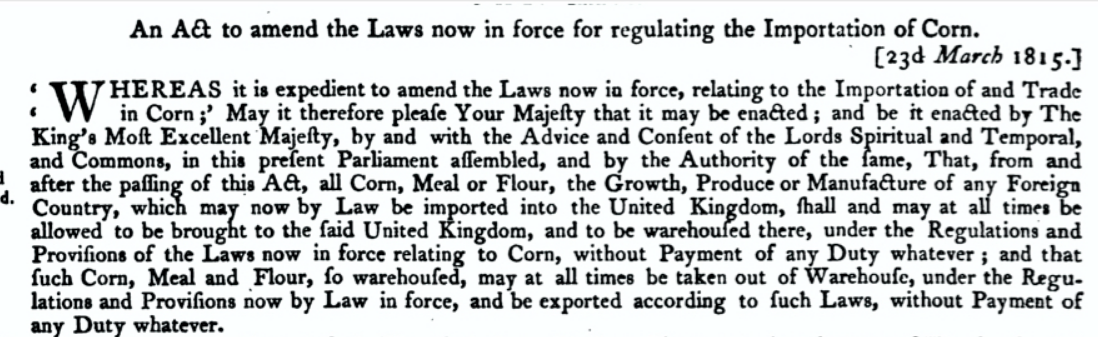
Sir Robert Peel repealed the Corn Law in 1846. This made the ownership or agricultural land far less profitable and possibly lead to Thomas Ruggles giving up title to the manor in 1865.
The monarch in 1815 was George III - William IV was on the throne when the act was repealed in 1846
Samuel Raymond junior and the church - The Prenup
Samuel Raymond, father of Samuel Millbank and grandfather of John Mayne St. Clere, seemed to be concerned with Samuel Millbank's younger brother (the 3rd son). A prenuptual marriage agreement was drawn in 1817 that effectively made an agreement that Oliver took up Holy Orders on his marriage to Anne Andrews.
My analysis is based mainly on the Freer Tree (there could be errors). Never-the-less there is a prenuptual agreement in the Essex Archive.
John Mayne St. Clere Raymond features on this page due to the renovations at St. Mary's (1865) and the building of the New School House (1871).