Suffolk Manors
Having found a wealth of information on Essex from Thomas Wright's History and Topography of Essex, the
references he makes to neighbouring Suffolk locations are not so easy to research as I had not found a similar
account that covered Suffolk or Norfolk. Seeing that Belchamp Walter is located on the Essex Suffolk border
knowledge of the towns and villages near-by is essential.
Belchamp Walter's nearest market town is Sudbury Suffolk. In fact the postal address is Sudbury Suffolk even
though it is actually in Essex.
There is copy of this publication available on archive.org. I will copy and paste sections of the document that
are relevant to my history of Belchamp Walter.
Top
Apart from the town of Sudbury, there many key locations that feature in Belchamp Walter's history. These include
Clare, Edwardstone and Gipping.
Clare, Suffolk, is obvious because of the de Clare dynasty and that much of Sudbury's history has involvment of
the family in its history. Elizabeth de Burgh was influential in many of the developments in Sudbury
Edwardstone, could be a clue in the name, is mentioned with relation to the Montecansyo name. The connection here
with respect to the Anarchy and the 12th and 13th century developments between vying elements of the Normans.
Gipping is the seat of the Tyrells, many connections here. Ties to the Wentworths of
Gosfield and possibly to the "prices in the tower"
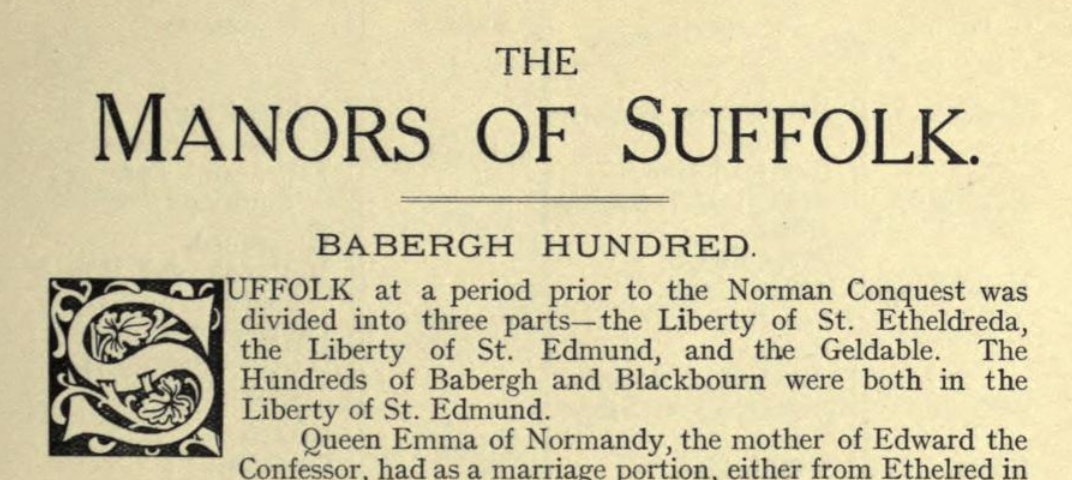
The quoted text from the image above (Manors of Suffolk)
Babergh Hundred
SUFFOLK at a period prior to the Norman Conquest was divided into three parts the Liberty of St. Etheldreda, the Liberty of St. Edmund, and the Geldable. The Hundreds of Babergh and Blackbourn were both in the Liberty of St. Edmund.
Queen Emma of Normandy, the mother of Edward the Confessor, had as a marriage portion, either from Ethelred in 1002,
or from her second husband Knut in 1017, jurisdiction in eight Hundreds and a half adjoining the Monastery of St. Edmund; Elfric son of Earl Withgar and afterwards Ordgar having custody of the franchise.
After the Coronation of the Confessor in 1043 he took into his own hands the possessions of his mother, to whom he does not appear to have been very favourably inclined, and on the petition of the Monks of St. Edmund bestowed upon them the eight hundreds and a half, and the gift was confirmed to the Monks by William the Conqueror.
Sudbury is descibed in The Manors of Suffolk.
Six volumes
Although I have found much information from the volume I have found and downloaded I feel that there is
much missing. In the note at the start of volume 1 it says:
The present is a kind of trial volume, and forms the first instalment of six like volumes already written on the Manors of Suffolk. Should it meet with acceptance, the volumes will be sent to press so soon as a sufficient number of copies have been subscribed to repay the cost of printing. No doubt more might have been said respecting
the manors, and especially the manor houses, but in view of the
fact that there are about 2,000 manors in Suffolk, and the
expediency of restricting the work to seven volumes, little more
than dry facts could be given to speak for themselves.
Sudbury and Babergh are covered but some of the other Hundreds in the middle and north of Suffolk are
not in this volume.
Rushbrooke and the Jermyms are mentioned but the manor of Rushbrooke is not. Eye, Suffolk, is described as
is the manor of Theltenham (the reference to the Malet family)
About Copinger
Copinger was interested also in genealogy, heraldry, and manorial history. In 1882 he published his History of the Copingers or Coppingers (new enlarged edit. 1884), in which he traces the descent of his family from the Danes in the tenth century, when they appear to have settled in Suffolk and in the south of Ireland. In his last years he concentrated on the history of Suffolk. In 1902 he issued the History of the Parish of Buxhall, of which he was lord of the manor. Between 1904 and 1907 the History of Suffolk as described by Existing Records (in 5 vols.) made its appearance together with the Manors of Suffolk: Notes on their History and Devolution (7 vols. 1905–11). He also compiled the History of the Smith-Carrington Family (2 vols. 1907), which was severely criticized for its dependence upon inauthentic sources,[3] and wrote Heraldry Simplified, which appeared in the year of his death.[2]