Belchamp Walter School House - (Trust deed 1871)
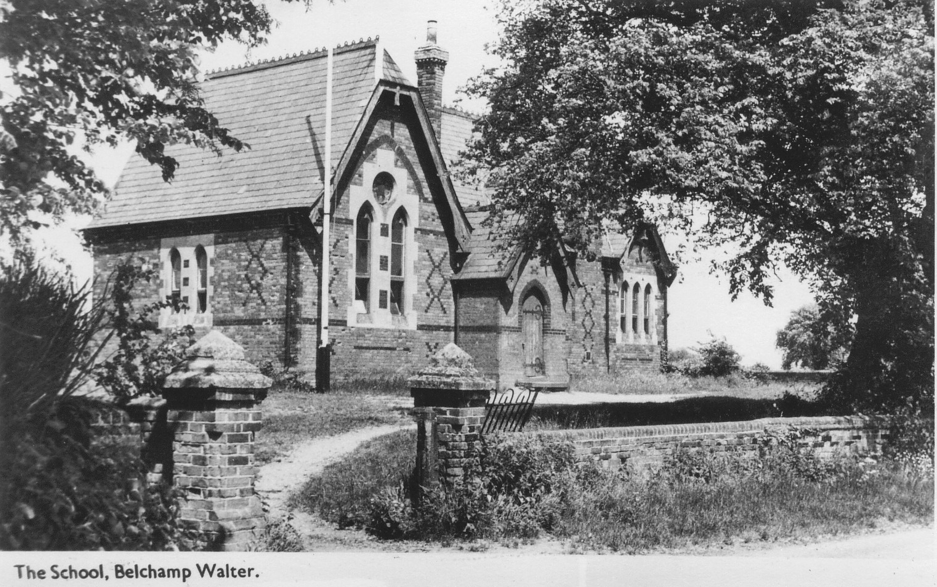
The "new" School House is now the Belchamp Walter Village Hall. The building was opened as Belchamp Walter School in 1872.
The new school house was built to replace the Old School House which ran out of space in 1870.
The school house was closed in 1963 and is now used as the Belchamp Walter Village hall.
Village Hall/School House
The description on the Historic England website:
John Mayne St. Clere Raymond's wife laid the foundation stone of the School House in 1872 - This was after he had repurhased the Manorial Lands (for its farm income) in 1863.
1872
The date on the plaque on the gable of the village hall says 1871 the commissioning, building and operation of the "new" School House was 1871 and 1872.
According to Samuel Philip's speech ---- (Samuel Philip was known as Philip in the copy I have scanned) the "paper" was given to Walter Deal, at the Centenrey Supper in 1972 (29th July).
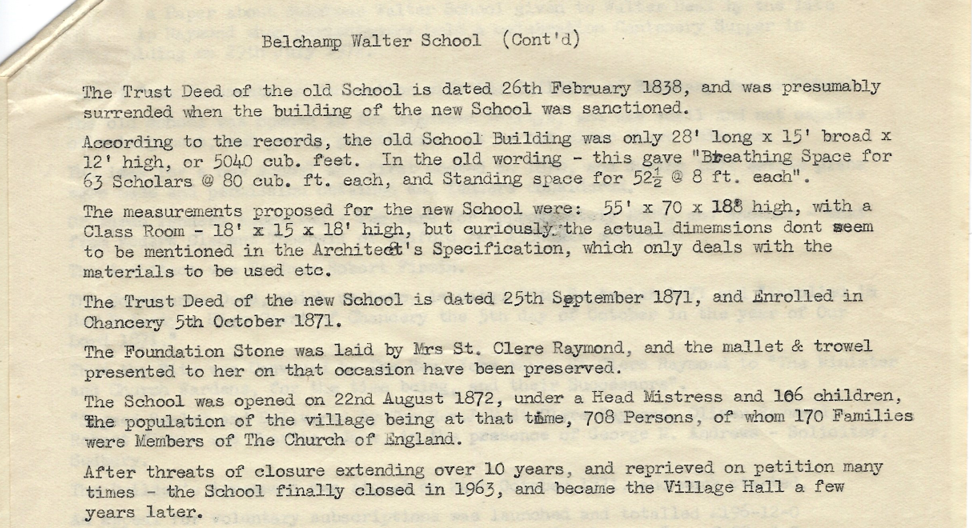
Oliver Raymond was the vicar in 1872, the uncle of John Mayne St. Clare Raymond who is listed as the vicar of St. Mary's until 1889.
Oliver Raymond was the rector of Middleton and vicar of Belchamp-cum-Bulmer.
Samuel Millbank Raymond and Oliver Raymond were brothers and sons of Samuel Raymond (d. 1825).
J. M. S. Raymond was Samuel Millbank's son. John. Mayne. St. Clare Raymond took over the "residency" at St. Mary's after the opening of the school.
The foundation stone was laid by Mrs. J. M. S. Raymond (1871-1872) and the mallet and trowel are held currenty at Belchamp Hall.
At the time of opening (1872) the school management committee was:
- Oliver Raymond (G2 - there is an error on the Freer tree and should be G3) - the Vicar (In this case it was Oliver Raymond, Rev., Rector of Middleton, Vicar of Belchamp-cum-Bulmer, * 1794, + 1889, Md. 1817, Anne Andrewes, + 1863, d. of Rev. Charles Andrewes, Rector of Flempton, Suffolk).
- Vicar's Warden - Robert Firmin
- People's Warden - Mr Charles Adams
- Mr William Wright, Mr Henry Mann, Mr George Washington Brownlow,
The estate was "re-purchased" in 1865 by J. M. S. Raymond from Thomas Ruggles. It is not clear whether the school house was part of this estate. Most of the village surounding the village pond at the cross-roads was owned by the Ruggles family during the years 1741 to 1865.
Repairs on the Village Hall
As the building is of Victorian heritage it requires on-going maintenance. The windows are in desperate need of renovation. Much of the wooded framing is rotting and the whole village hall needs painting.
1921 Auction
It is also not clear whether the school house was part of this auction. It is likely that it was not and the ownership of the School House was retained by the Raymond Estate.
Village Hall Lease
At the time of writing this there is no formal lease between the Parish Council (the owners) and the Village Hall Committee (the Charity).
At the time of the school closing there was a lease created between the Village Hall committee and the Raymond family. It was then that there was an agreement that the BWVHC would be Management trustees and the PC would "hold" the lease.
Since that time the freehold has been transferred to the Parish Council who are the legal owners of the Village Hall.
The questions are, did the school building revert to the original owners of the land or did the Church of England still hold the title? The Trust Deed Title was transferred to the Reverend Oliver Raymond and the church wardens in 1871. Oliver Raymond did not reside at Belchamp Hall and he was the uncle of the person who signed the lease with the Village Hall. Oliver was the minister of Belchamp Walter church in 1871 and I think he lived in Bulmer or Middleton.
The text from the speech given at the buildings centential celebrations by Philip Raymond, the father of Michael Raymond who signed the lease with the Parish Council says:
It should be noted that the speech is not a legal document and the usage of the phrase "For the time being" is not clear.
A copy of the speech can be found on this website.
Nepotism
This is somewhat understandable in some of the arrangements with respect to the building of the New School house. That being said it is interesting to highlight how this manifests itself here.
The architect was Firmin - the People Warden was Firmin
The Solicitor was Andrews - the father-in-law of Oliver Raymond was Andrews
The Education Act
My page on the Rev'd Oliver Raymond, the Trust Deed holder in 1871, the Education Act of 1870 came to light. The building of the school appears to have been a consequence of that Act.