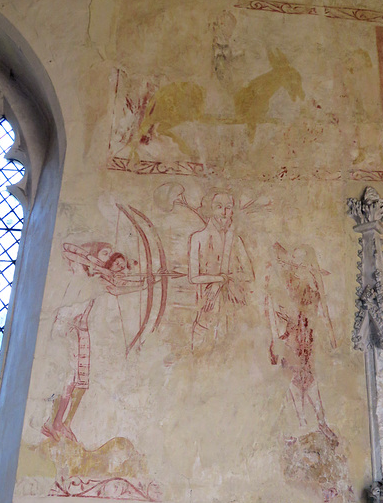
Featured in the medieval wall paintings at Belchamp Walter
27 June 2026 - Access seen in logs
Edmund the Martyr (also known as St Edmund and Edmund of East Anglia, died 20 November 869)[note 1] was king of East Anglia from about 855 until his death.
Few historical facts about Edmund are known, as East Anglia was devastated by the Vikings, who destroyed any contemporary evidence of his reign. Coins minted by Edmund indicate that he succeeded Æthelweard of East Anglia, as they shared the same moneyers. He is thought to have been of East Anglian origin, but 12th-century writers produced fictitious accounts of his family, succession and his rule as king. Edmund's death was mentioned in the Anglo-Saxon Chronicle, which relates that he was killed in 869 after the Great Heathen Army advanced into East Anglia. Medieval versions of Edmund's life and martyrdom differ as to whether he died in battle fighting the Great Heathen Army or if he met his death after being captured and then refusing the Viking leaders' demand that he renounce Christ.
Saint Edmund the Martyr - King of East Anglia - Reign c. 855 – 20 November 869
The painting of St Edmund is at the bottom left of the group on the North Wall of
St. Mary the Virgin, Belchamp Walter.
The scene is common depiction of St. Edmund tied to a tree and shot with arrows.
Top
Background on St Edmund
St Edmund could have been the patron saint of England, as opposed to St. George.
Belchamp Walter is only 10 miles south of Bury St. Edmunds, Suffolk.
Bury Saint Edmunds is the site of the former Benedictine abbey.
Wikipedia says:
"
Edmund the Martyr (also known as St Edmund or Edmund of East Anglia,
died 20 November 869) was king of East Anglia from about 855 until his death.
"
English Heritage say:
"
Located in the heart of Bury St Edmunds, the abbey was once one of the richest and most powerful Benedictine
monasteries in England.
Its remains are extensive and include the complete 14th century Great Gate and Norman Tower, as well as the impressive ruins and altered west front of the immense church.
"
"
The relics of the martyred Anglo-Saxon king St Edmund, whose remains were moved to this site in 903, and his
shrine became a place of pilgrimage.
The abbey itself was founded in 1020 and grew in power and wealth up until its suppression in 1539.
"
Edmund of Abingdon
Edmund the Martyr should not be confused with St. Edmund of Abingdon, born in 1174 and Archbishop of Canterbury, 1134.
Edmund of Abingdon had some dispute with Henry III and was sent to the Welsh Marshes to negotiate peace with
Llywelyn the Great. He was also involved with Simon de Montfort, 6th Earl of Leicester, and the 2nd Baron's War.
He condemed the marriage of Simon to Eleanor of England as Edmund Rich.
Order of the Garter - Edward III - 1348
Edward III
.