Vicar of Belchamp Walter - 1859
Vicars of St. Mary Belchamp Walter
This page was prompted after seeing a history being posted on the Village Hall website regarding the history of the village hall. The text seems to have been retrieved from the original text that was posted on the VHC website. One wonders who have been talked to? Seeing that it was not known when I asked where the information that was on the Village Hall website came from I was told that they did not know (Colin). I removed the text when I was running the website as I was frustrated that I was getting no feedback.
I think that the subject of this page needs to be posted as it seems that the VHC may be searching for ways to make themselves seem relevant. Whether this will have any effect on their attempts to get grant funding, who knows. I also see that it is not totally clear what happened when the New School House was built. As I have said this may well be accademic.
There is also a tie-in with John Mayne, the John Mayne who married Isabella Raymond, his father was a signatory on the prenuptual.
Reviewing this page and the one on the school house there still seems to confusion. The Trust Deed seems to have been conveyed to JMSR from JSMR???? Or it could have been to the Minister who was Oliver Raymond (Middleton).
Having met the grandson of the Reverend Oliver Raymond who confirmed some of my suspicions relating to the history of the church and village in the 1870's. The building of the School House and the Education Act. The visitor to the church looking for connections to his grandfather was also going to visit Middleton church.
This page has been accessed on a couple of occasions since meeting the grandson and I see that there is no link to my Middleton page on this page.
Reverend Oliver Raymond
The Reverend Oliver Raymond was the 3rd son of Reverend Samuel Raymond (d. 1825), he was the Minister of St. Mary's from 1859 until 1863 when his nephew took on the role.
It is not clear from church records what was going on the the church and the Raymond family at this time. However I think that it is safe to say that there were some disputes.
I think that it is safe to conclude that there was something going on between the offspring of Samuel Senior.
From what I can see this would include Samuel Millbank, Rev Oliver and Isabella. This Isabella Raymond married Rev. Henry Yeates Smythies in 1809. Isabella was born in 1784. Isabella and Henry Yeats were the grandparents of Raymond Henry Raymond (buried in St. Mary's Churchyard)
What was the dispute?
This is not clear.
There were obvious concerns and there was a prenuptual drawn up for the marriage of Oliver and Anne Andrews, of Middleton, Essex.
Samuel Millbank, the older surviving brother of Oliver and Isabella (also known as "Squire Raymond") has a portrait current in Belchamp Hall painted by George Washington Brownlow. The composition of Samuel Millbank with his favourite dog.
Top
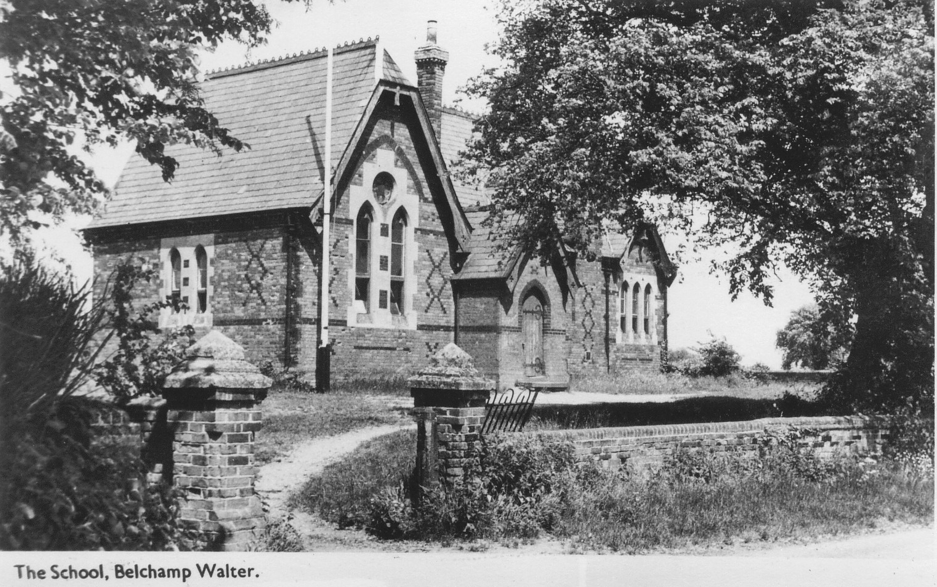
It appears that Oliver was the minister of St. Mary's leading up to the construction of the New School House.
The trust for the New School House was conveyed to Oliver Raymond (the minister of the church at the time) and the church wardens from John Mayne St. Clere Raymond in 1871
The Education Act 1870
It is not clear what the significance is here as the new school was built very soon after this act of parliament. It would seem that education was up until this point something that was possibly sponsored by the church.
This is supported by the quote below from the englandhistory.com website:
The Education Act of 1870, also known as the Forster's Education Act, was a landmark piece of legislation passed during the Victorian period in Great Britain. The act was introduced by William Forster, a Liberal MP, and was designed to address the issue of widespread illiteracy among the working-class population.
Prior to the Education Act, education in Britain was largely the responsibility of religious and charitable organizations, and many children, particularly those from poorer families, received little or no formal education. The Forster's Education Act aimed to change this by establishing a system of elementary schools that would be accessible to all children, regardless of their social class or religious affiliation.
Under the act, school boards were established in each local area, with the power to levy taxes and build and operate schools. The boards were also responsible for ensuring that all children between the ages of 5 and 13 attended school, and for enforcing attendance laws. The act also established a system of teacher training and set minimum standards for school facilities and curriculum.
The Education Act of 1870 was a significant step forward in terms of providing universal access to education in Great Britain. Prior to the act, many children, particularly those from working-class families, had little or no access to formal education, and illiteracy rates were high. The act helped to change this by establishing a system of elementary schools that was accessible to all, and by setting standards for school facilities and curriculum.
The act was also significant in terms of its impact on social mobility and economic growth. By providing greater access to education, the act helped to open up new opportunities for children from working-class families, and paved the way for a more educated and skilled workforce.
Overall, the Education Act of 1870 was a landmark piece of legislation that helped to transform the educational landscape of Great Britain. It was a significant achievement of the Victorian period, reflecting a growing commitment to social reform and the idea that education was a key to unlocking individual and societal potential.
The building of the New School House is more than likely to have been as a consequence of this Act and funding was provided by the government to pay for a lot of the work.
The involvement of the Church of England is not clearly addressed in the quote above, but it looks like the New School House was indeed a C. of E. school with then government backing.
Church of England Schools
The quote below is from the Chester Board of Education (part of the Diocese of Chester) reiterates this:
By the time of the national census of 1851, forty years later, the Church had established 17,000 schools. State provision for public education came with the 1870 Education Act by supplementing the churches' provision. This Act demonstrated the partnership between the state and the churches in education, which has continued to the present day. At the beginning of the 20th century there were over 14,000 voluntary schools of which rather more than 1,000 were Roman Catholic, and a similar number provided by the Wesleyans and others and the majority of the rest were Church of England.