The Great Cause
The quest for a king for Scotland - 1292-1296
John de Botetourt was involved with this. He was both in Edward I's service initially in Gloucestershire and then in Scotland.
My research into Botetourt in the People of Medieval Scotland shows Sir John acting on the orders of Edward I in 1296 at St. Braivells. He appears to be the gaoler to Scotish prisoners from the Battle of Dunbar. He later appears as a messenger for Edward and then as an admintrator (Justicar) in Dunfries and Galloway. Another paper, a thesis by ??, revealed John as the Constable of Dalwinton (Comyns) Castle. John Comyn, another contender for the king of Scotland, was murdered - possibly under orders from Edward.
The Great Cause is process used in Scotland to choose a new king. After the death of Alexander III there were 13 Competitors for the Crown of Scotland. Of these were John Balloil, Robert Brus and John Hastings. Edward I offered to help, but it was more like that he wanted to be the dominant power north of the border.
John Balloil did become king of Scotland but the struggle between the Balloil and Brus led to Braveheart. The English were defeated at the Battle of Stirling Bridge by William Wallace. Wallace was suceeded by Robert the Bruce
The Great Clause
Searching for "The Great Clause" AI came up with:
The Great Cause refers to the contested succession crisis in Scotland from 1290 to 1296, following the death of King Alexander III and the subsequent claimants to the Scottish throne.
Historical Context
The Great Cause emerged after the death of King Alexander III of Scotland in 1286, which left the throne vacant. His only surviving descendant, the Maid of Norway, died in 1290, further complicating the succession. This led to a power struggle among thirteen claimants to the Scottish crown, including notable figures such as John Balliol and Robert de Brus (Bruce).
The Role of Edward I
Fearing civil war, the Guardians of Scotland sought the arbitration of Edward I of England. He agreed to oversee the proceedings but aimed to exert English control over Scotland, which led to tensions. A commission of 104 auditors was established to evaluate the claims, ultimately ruling in favor of John Balliol in November 1292. However, this decision was met with resentment, as many viewed it as a means for Edward to establish a puppet monarchy in Scotland.
Consequences and Significance
The Great Cause set the stage for the Scottish War of Independence, which began shortly after Balliol's ascension. The conflict arose from the dissatisfaction with English interference and the desire for Scottish autonomy. The period is significant in Scottish history as it marked the beginning of a long struggle for independence, culminating in the eventual rise of Robert the Bruce as a key figure in the fight against English rule.
Top
Edward I and the magnats and barons that supported him certainly had an impact on the Scots. Michell says that many of the more powerful English magnats refused to help him.
Hereford and Pembroke probably could be described as "powerful" but in 1311 this was after the "hammering".
1311 was the year that the Ordinances were drawn up and published. The Lord Ordainers (not that they were known as such at the time) included John de Botetourt, Aymer de Valence - 2nd Earl of Pembroke and Humphrey de Bohun, 4th Earl of Hereford.
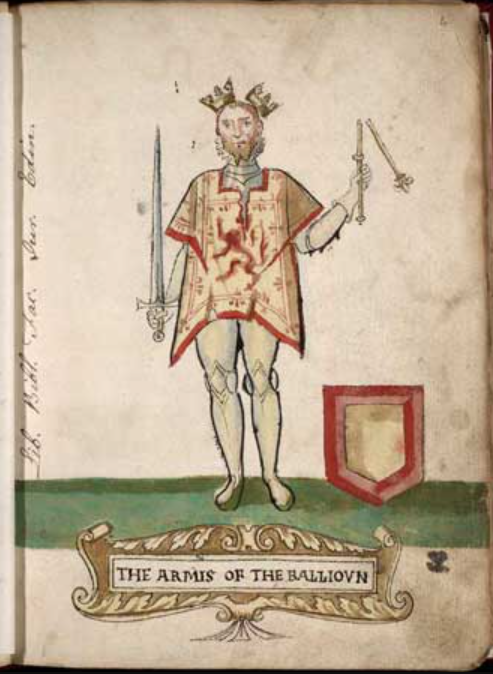
King John Balloil
John Balloil was known as "the Puppet King" of Scotland (hence the depiction)
Margaret, Maid of Norway
Margaret was the daughter of King Eric II of Norway and Margaret of Scotland. By the end of her maternal grandfather's reign, King Alexander III of Scotland, she was his only surviving descendant and recognized heir presumptive. Alexander III died in 1286, his posthumous child was stillborn, and Margaret inherited the crown.
John Comyn III of Badenoch
Auld Alliance
The Auld Alliance was an alliance between the kingdoms of Scotland and France against England made in 1295.
Edward of Caernarfon
The future Edward II was promised to Margaret, Maid of Norway, who was the heir presumptive of King Alexander III of Scotland but died of food poisoning on her way from Norway to Scotland.
In 1290, Edward's father had confirmed the Treaty of Birgham, in which he promised to marry his six-year-old son to the young Margaret of Norway, who had a potential claim to the crown of Scotland.[40] Margaret died later that year, bringing an end to the plan.
The death of Margaret set the scene for the Great Cause.
Margaret (Norwegian: Margrete, Scottish Gaelic: Maighread; March or April 1283 – 26/29 September 1290), known as the Maid of Norway, was the queen-designate of Scotland from 1286 until her death. As she was never inaugurated, her status as monarch is uncertain and has been debated by historians.
Margaret, was betrothed to the future Edward II before Alexander III but did not reach Scotland.
Owing to her young age, she remained in Norway rather than go to Scotland. Her father and the Scottish leaders negotiated her marriage to Edward of Caernarfon, son of King Edward I of England. She was finally sent to Great Britain in September 1290 but died in Orkney, sparking the succession dispute between thirteen competitors for the crown of Scotland.
1303 - Dumfries and Galloway
After the Great Cause and during the reign of John Balloil Sir John de Botetourt was a justicar and Edward I's messenger in Scotland.