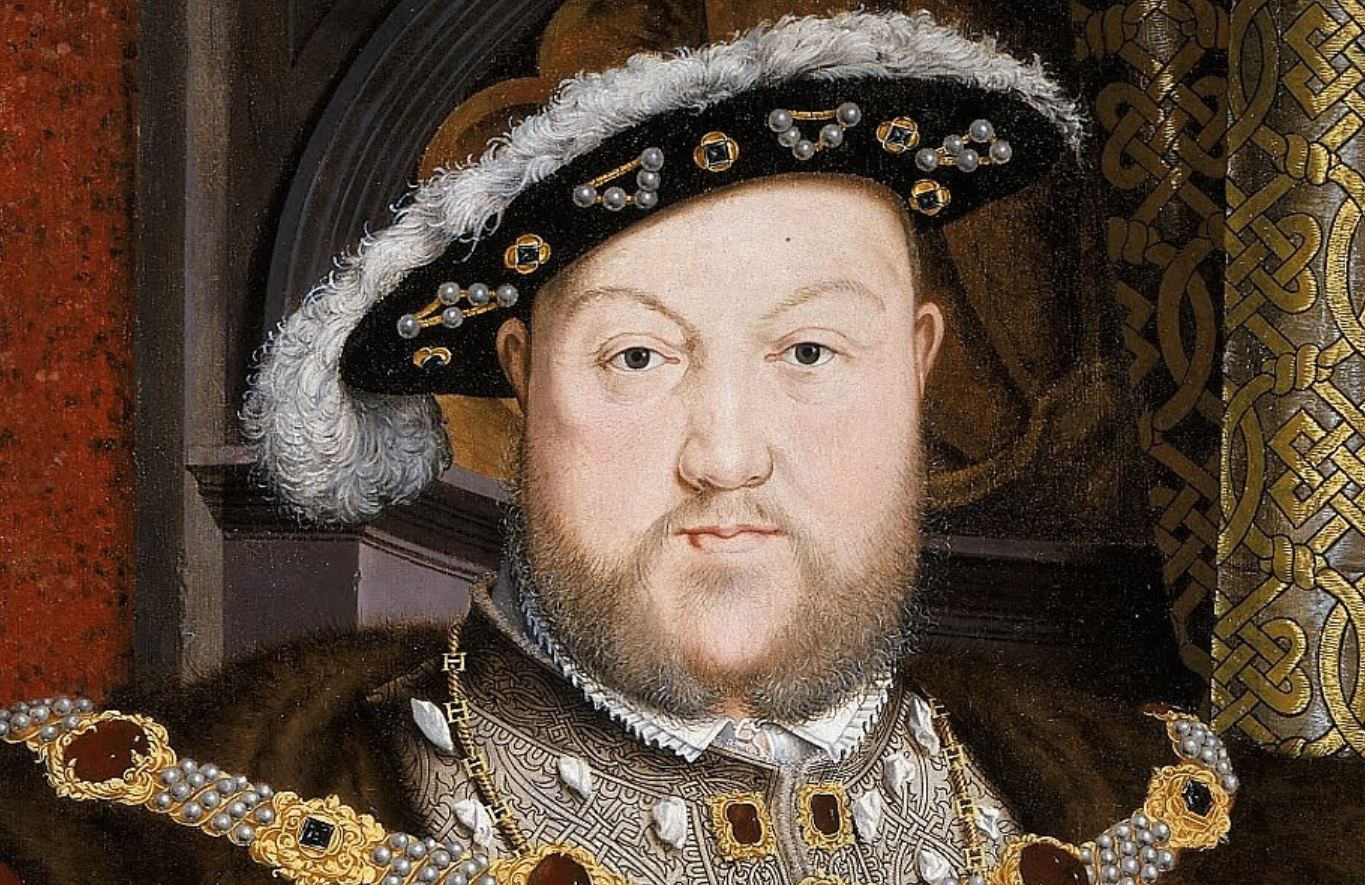
The king with the 6 wives
Henry VII - 1509-1547 - 1509-1547 - Edward VI - Mary I 1583 - Elizabeth I - 1583
Dissolution of the monasteries 1536-1541 - Field of the Cloth of Gold 1520
Catherine of Aragon - Anne Boleyn - Sir William Boleyn - Jane Seymour - Anne of Cleves - Catherine Howard - Catherine Parr
Tudor Belchamp
My page on Henry VIII has been left rather late in my general history pages as much of his story has been told by others in many places. Of course, the Tudors had a major influence on the history of Belchamp Walter and the surrounding area and much of the movement of families of the region can be explained.
An irony is that Belchamp Walter has the actor of Wolf Hall having a home in the village.
Henry VIII - Reign: 21 April 1509 – 28 January 1547
Henry VIII and the Tudor era saw many families associated with Belchamp Walter. The Disolution of the monesteries with the appointment of Tudor officials to adminster the lands confiscated from the religious houses saw a possible construction of a Tudor Manor house at Belchamp Walter. This dwelling is most probably was for a member or cadet member of the Wentworth family.
Top
Henry had a great influence on the church and state and the recording of the history of the country and
also of the church and general population.
Thomas Cromwell
Thomas Cromwell (/ˈkrɒmwəl, -wɛl/;[1][a] c. 1485 – 28 July 1540), briefly Earl of Essex, was an English statesman
and lawyer who served as chief minister to King Henry VIII from 1534 to 1540,
when he was beheaded on orders of the king, who later blamed false charges for the execution.
Sir Richard Rich
Sir Richard Rich Henry's Lord Chancellor whose tomb can be found in Felsted
church, was Henry VIII's man to implement the Dissolution of the Monasteries
Richard Rich, 1st Baron Rich (July 1496 – 12 June 1567), was Lord Chancellor during
King Edward VI of
England's reign, from 1547 until January 1552. He was the founder of Felsted School with its associated
almshouses in Essex in 1564. He was a beneficiary of the Dissolution of the Monasteries, and persecuted
perceived opponents of the king and their policies. He played a role in the trials of Catholic martyrs
Thomas More and John Fisher as well as that of Protestant martyr Anne Askew.
From the Wikipedia page on Leez Priory:
In 1220, Sir Ralph Gernon decided that the hamlet of Leez, in a dip by the banks of the River Ter, would
provide the perfect location on which to found a house of Augustinian canons. The priory of St. Mary and
St. John the Evangelist thrived for over 300 years. King Henry VIII sent Sir Richard Rich to dismiss
the monastery, during the Dissolution of the Monasteries (1536-1541). When Sir Richard Rich,
3rd Baron Rich became the Earl of Warwick, he built his own great house on the site that is now known
as Leez Priory. The remains of the Augustinian Priory are very much in evidence within the grounds
to the south of the existing buildings, including extensive underground drainage conduits.
Known as "Delicious Leez", both the site and the rose-brick buildings are breathtaking,
with old garden walls and fish ponds indicative of life and times past.
Catherine of Aragon
Boleyn
Thomas Boleyn, Earl of Wiltshire, 1st Earl of Ormond,[1] 1st Viscount Rochford KG[2] KB (c. 1477 – 12 March 1539), of Hever Castle
in Kent, was an English diplomat and politician who was the father of Anne Boleyn, the second wife of King Henry VIII, and was thus the maternal grandfather of Queen Elizabeth I. By Henry VIII he was made a knight of the Garter in 1523 and was elevated
to the peerage as Viscount Rochford
in 1525 and in 1529 was further ennobled as Earl of Wiltshire and Earl of Ormond.
Anne Boleyn
Jane Seymour
Howard
Lady Catherine Howard of Tendring Hall - Stoke by Nayland
Catherine Howard[b] (c. 1523 – 13 February 1542) was Queen of England from July 1540 until November 1541 as the fifth wife of ing Henry VIII. She was the daughter of Lord Edmund Howard and Joyce Culpeper, a cousin to Anne Boleyn (the second wife of Henry VIII), and the niece of Thomas Howard, 3rd Duke of Norfolk. Thomas Howard was a prominent politician at Henry's court. He secured her a place in the household of Henry's fourth wife, Anne of Cleves, where Howard caught the King's interest. She married him on 28 July 1540 at Oatlands Palace in Surrey, just 19 days after the annulment of his marriage to Anne. He was 49, and it is widely accepted that she was about 17 at the time of her marriage to Henry VIII.