Mortimer and Edward II
Marcher Lord - Queen Isabella and Roger Mortimer - The Percy Family
Wikipedia quotes moved from body
"
The surname Mortimer has a Norman origin, deriving from the village of Mortemer, Seine-Maritime, Normandy. A Norman castle existed at Mortemer from an early point; one 11th century figure associated with the castle was Roger, lord of Mortemer, who fought in the Battle of Mortemer in 1054.[1] The 12th century abbey of Mortemer at Lisors near Lyons-la-Forêt is assumed to share the same etymological origin, and was granted to the Cistercian order by Henry II in the 1180s.
Elizabeth Mortimer, Lady Percy
"
Elizabeth Mortimer, Lady Percy and Baroness Camoys (12 February 1371 – 20 April 1417), was a medieval English noblewoman, the granddaughter of Lionel of Antwerp, 1st Duke of Clarence, and great-granddaughter of King Edward III. Her first husband was Sir Henry Percy, known to history as 'Hotspur'. She married secondly Thomas Camoys, 1st Baron Camoys.
There seems to be an error (or ommission) on Alan Freer's Conq tree as Elizabeth is shown as a daughter
"
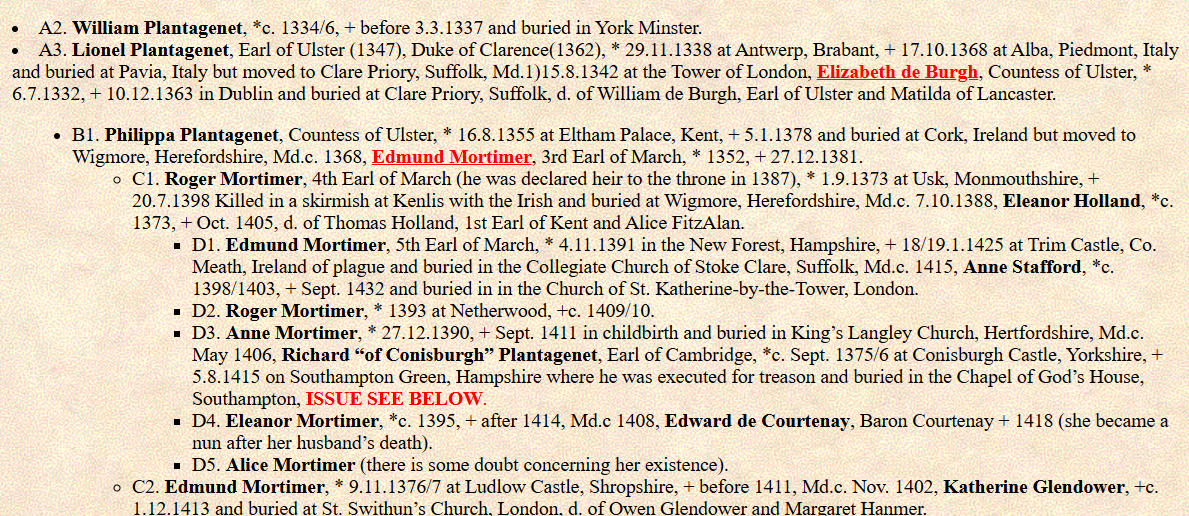
Philippa of Clarence also known as Philippa Plantagenet or Philippa de Burgh (16 August 1355 – 5 January 1382)
was a medieval English princess and the suo jure Countess of Ulster.
"
Roger Mortimer, 1st Baron Mortimer of Chirk (c.1256 – 3 August 1326) was a 14th-century Marcher lord, notable for his opposition to Edward II of England during the Despenser War.
Roger Mortimer, 1st Earl of March
"
Roger Mortimer, 3rd Baron Mortimer of Wigmore, 1st Earl of March (25 April 1287 – 29 November 1330), was an English nobleman and powerful marcher lord who gained many estates in the Welsh Marches and Ireland following his advantageous marriage to the wealthy heiress Joan de Geneville, 2nd Baroness Geneville. Her mother was of the royal House of Lusignan. In November 1316, he was appointed Lord Lieutenant of Ireland. He was imprisoned in the Tower of London in 1322 for having led the marcher lords in a revolt against King Edward II in what became known as the Despenser War.
Wikipedia says about William la Zouche:
William la Zouche, 1st Baron Zouche (1276/86–1352), lord of the manor of Harringworth in Northamptonshire,
was an English baron and soldier who fought in the Wars of Scottish Independence. He is referred to in
history as "of Harringworth" to distinguish him from his first cousin (of the senior line) Alan la Zouche,
1st Baron la Zouche (1267–1314) of Ashby de la Zouch in Leicestershire.
Elizabeth Mortimer, Lady Percy and Baroness Camoys (12 February 1371 – 20 April 1417), was a medieval English noblewoman, the granddaughter of Lionel of Antwerp, 1st Duke of Clarence, and great-granddaughter of King Edward III. Her first husband was Sir Henry Percy, known to history as 'Hotspur'. She married secondly Thomas Camoys, 1st Baron Camoys. She is represented as 'Kate, Lady Percy,' in Shakespeare's Henry IV, Part 1, and briefly again as 'Widow Percy' in Henry IV, Part 2.
The Mortimer Family
Elizabeth Mortimer was the daughter of Lady Philippa Plantagenet and Edmund Mortimer, Earl of March. She was also titled Lady Percy and Baroness Camoys
The Mortimer family were of Norman origin and took their name from Mortemer, Seine-Maritime, Normandy.
Queen Isabella, the spouse of Edward II, "took up" with Roger Mortimer
Elizabeth Mortimer was Lady Percy
Lady Philippa Plantagenet
Lady Philippa Plantagenet, Countess of Ulster was the spouse of Edmund Mortimer, daughter of Lionel Plantagenet and Elizabeth de Burgh.
Lionel Plantagenet was the grandson of Edward III and third son of Edward the Black Prince.
Top
Roger Mortimer, 1st Baron Mortimer of Chirk
Eleanor de Clare (Eleanor de la Zouche) was married to William la Zouche,
1st Baron Zouche of Mortimer (from the research of John Lloyd Marlow)
William la Zouche
Joyce Zouche (Botetourt) was the daughter of William la Zouche according to John Marlow but this does not show on the Wikipedia page. There is also a reference to the Battle of Bannockburn and the wars of Scotish independance. Another Botetourt cross-reference.