Great Wakering
The author of this website grew-up in Great Wakering.
The price of houses in Great Wakering would also be of interest.
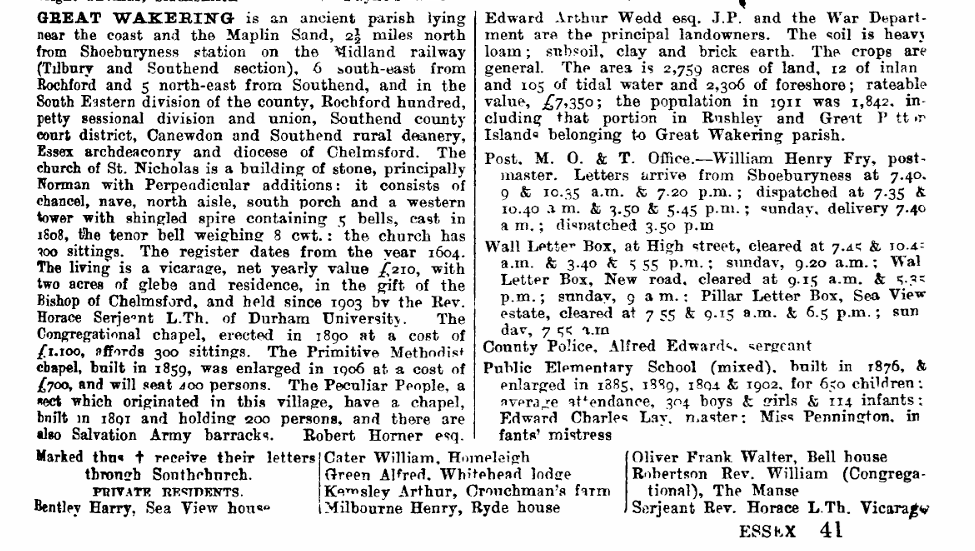
Seeing the page is making an impression the text on the Kelly's guides could be expanded. The copy that I have an image below was taken from the same file as my capture for Belchamp Walter. Actually I can't find this - the file rare_essex/73%20Kelly's%20Directory%20of%20Essex,%201914.pdf searched doesn't find it.
I now have the 1848 White's from Billericay Boy. (Needs formating) - should help with those making a search.
16 July 2026 - Visit to page (GSC) no query captured.
Great Wakering - Southend-on-Sea, Essex
The author of this website grew up in the village of Great Wakering on Twyford Avenue.
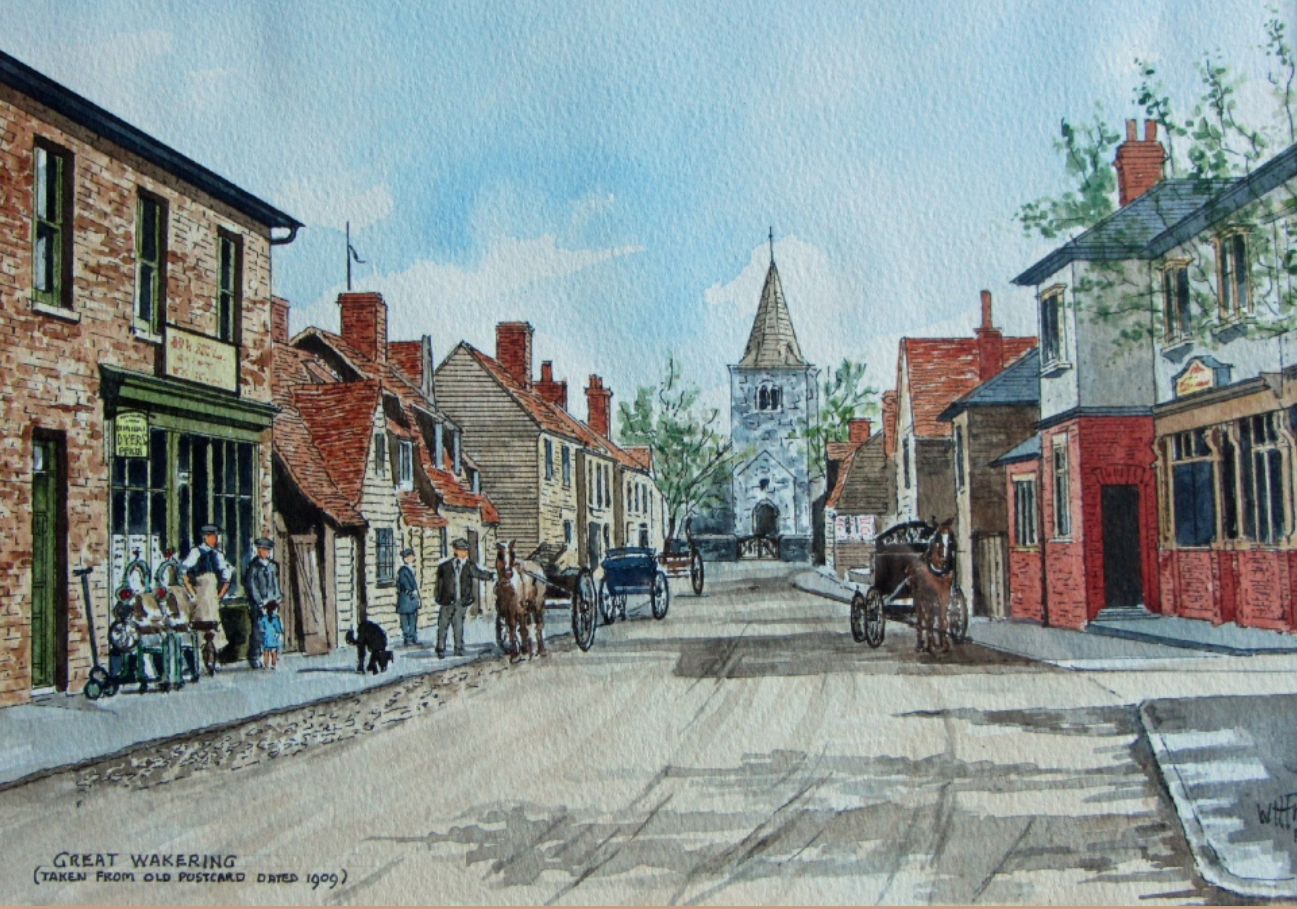
This page takes text from ESAH and describes the tithes in 1838.
In addition there is a description of the region at the time of the General Survey.
Great Wakering Parish (Rochford Hundred).
Great Wakering Tithe Award (Essex Record Office D/CT376A), dated 1838, shows a rent-charge of £657-2-0 payable to the Lay Impropriator, Thomas Clough of Bishops Stortford in Hertfordshire, and £290-6-0 to the vicar, Rev. Bernard Osborn of
West Tilbury, sequestrator of vicarial tithes and Rev. William Pritchard alias William Pritchard Gee, vicar now residing beyond the seas.
The total acreage of the parish was 2784 acres 1 rood 5 perches. Of the 2295 acres which were subject to tithes, 1850 acres were arable and 445 acres meadow and saltings. 60 acres were rectorial glebe and 2 acres vicarial glebe not in the hands of the owner.
The Tithe Commissioners were William Blamire and J. W.Buller, Assistant Commissioner Roger Kynaston. Robert Baker of Writtle
was Valuer and Surveyor. The Tithe Map dated (D/CT376B) was surveyed at a scale of 6 chains to the inch (13.3 inches to a mile).
It measures 46x66 inches.
In Domesday, Wachelinga(m) was held by Swein of Essex as one manor for 5½ hides. One hide was held in this manor by Garner and W (Morris, 1983). Wacrinense (monasterium) was documented in c1150), Wakering (e) Magna in 1254 and Muche Wakeryng in 1431-42, translated as 'the settlement of the followers of Wacor' (Ekwall, 1960; Reaney, 1935),
There were two manors:
1. Great Wakering. John de Nevill (died 1282) had the manor which Robert de Brus held under him for one knight's fee. Henry Bouchier, Earl of Essex, held it at his death in 1483. The manor house, demolished before Morant's time, stood at Pales Pitt at the entry to the Street.
2. Barrow-Hall, whose house stood half a mile west of the church (in 1875 in Little Wakering), was once called Berrewera and
Villa de Berwe. In 1503 Sir John Shaa held the manor. Adams Fee named from Adam Fitzsimon alias Aldhams Fee alias Aldermans was a reputed manor which went with Barrow Hall, a farm on the road to the church (Morant, 1768).
St. Nicholas Church
The church dedicated to St Nicholas was given to Beeleigh Abbey, the rectory being in its gift until 1283 when the Bishop of London appropriated the Great Tithes. At the Suppression of the Monasteries, the rectory was granted to the Master of the Hospital of St Thomas the Martyr in Southwark, then in 1551 to John Gresham (Morant, 1768).
Landwick (tithe parcel 193) is Landwyk in 1348, probably 'dry land dairy farm'.
Oxenham (parcel 176) is Oxonhamme in 1358, 'oxen enclosure'. Aldborough (Oldbury, OS c1875) (parcel 60) is Eldebery in 1419.
Polstead (parcel 28) is Polstede in 1326, dwelling at a pool or pit'.
Rebels (parcel no. 8) is Ravels in Chapman and André's map (1777).
References:
Ekwall, E, 1960. Dictionary of English Place-names. Oxford.
Morant, P, 1768. History and Antiquities of County of Essex, i, 304.
Morris, J, 1983. Domesday Book - Essex. Phillimore.
Reaney, P.H, 1935. Place-names of Essex. Cambridge.
According to a medieval tradition, Wakering (probably Great Wakering) was the site of a monastery during
the seventh century AD.
Two Christian cousins of King Ecgberht of Kent, named Æthelred and Æthelberht, were murdered at Eastry,
a royal dwelling in the Kingdom of Kent, during King Ecgberht's reign (664–673).
They were prevented by a miracle from being buried at Canterbury,
and were taken instead to an existing monastery at Wakering in the Kingdom of Essex and enshrined there
as saints.
Ecgberht's
brother and successor, King Hlothhere of Kent, is said by William of Malmesbury to have ridiculed the
idea of their sanctity.
Leslie 'Les' Stubbs
I attended school Les Stubbs' younger brother.
Les Stubbs played football for Southend United (1948/52 and 1958/60) and Chelsea (1952/58). There is a full tribute to him on the Barling and Wakering Heritage website - barlingwakeringvillages.co.uk
Chapman and Andre Map 1777

Domesday -
WACHELINGA [(Great) Wakering] is held by Suen in demesne as 5½ hides. Then as now (semper) 2 villeins, and 18 bordars, and 2 ploughs on the demesne; and a third could be employed (fieri). Then 3 ploughs belonging to the men; now 5. (There is) wood(land) for 40 swine, (and) pasture for 300 sheep. Then 4 rounceys (runcini), 9 beasts (animalia), 38 swine, (and) 115 sheep. Now 4 rounceys, 2 beasts, 110 sheep, (and) 27 swine. It was then worth 9 pounds; now 10. Of this manor Garner and W[ ] hold 1 hide, and have 2 ploughs; and it is worth 30 shillings in the above valuation (in eodem pretio).
The Rayner family of Great Wakering - By Albert Rayner Bsc (Econ) FCA
15 and 17 Twyford Avenue (Norfolk Villas) was sold by the Rayner family to the author's family in 1960.
This book is about the Rayner Family of Great Wakering including their connection with the Peculiar People. It also covers life in Wakering in the 19th and early 20th Century
The book was published in 1987 by A Rayner Bsc (Econ), Boston Spa,
Yorkshire and was printed by the Cambridge Press Printers, Shoeburyness. ISBN: 0-9512628-0-7
The contents of this booklet have been compiled by Albert Rayner Bsc(Econ) FCA, born 27 December 1902 only son
of John and Matilda Rayner.
Albert, known affectionately as Bert, lives near Leeds and is still very active, both as a financial director
to an engineering firm in High Wycombe and as Honorary Treasurer to Age Concern, Leeds. Bert, in kindly undertaking to write this booklet has, for the past five years, devoted a tremendous amount of energy
and time in research at:
- The Public Records Office, London.
- The Essex County Records Office, Southend-on-Sea.
The Parish registers at:
- Great Wakering
- Barling
- Little Wakering
- and Southchurch
The Peculiar People
96 Southend-on-Sea and district historical notes By Burrows, John William 1909.pdf
The Peculiar People a sect principally confined in membership to Essex have occupied of late a considerable amount of public attention, owing to the prosecution of members of that body for the consequences ensuing from their refusal to call in medical aid to their children. They had their origin towards the middle of the Nineteenth Century, through the preaching of James Banyard, of Rochford.
His teaching had a marked influence upon the agricultural population, and during the course of the last fifty years it may be said to have entirely changed the thought and
habit of hundreds of the men and women of South Essex.
The Peculiar People are honest, sober, and industrious, caring
for their own poor. They are mostly cultivators of market
gardens or agricultural labourers, though in the towns many
have entered into business, and some have become pos
sessed of considerable means. It is said in respect of one
district, Daws Heath, Thundersley, that they found it of evil
repute, and by their missioning zeal and industry transformed
it into one of the most prosperous agricultural communities of
the County. James Banyard's father was a ploughman at
Rochford Hall, and as he grew up the son followed a simila
Barling & Wakering Heritage website(s) - by Richard Kirton
Since I have obtained a package of scanned "rare" documents about the county of Essex, I have a renewed interest in Great Wakering and Southend-on-Sea.
Searching these documents for Wakering I found much more information on the area including much about Rochford and Leigh-on-Sea.
Kelly's
The Post Office Directory (Kelly's) for 1914 describes the village:
White's
Great Wakering 1848 Whites directory
WAKERING ( GREAT) is a large village, pleasantly situated on rising ground above the marshes, one mile from the sea shore, 5 miles E.S.E. of Rochford, and 4 miles E.N.E. of Southend.
Its parish contains 860 souls, and 2755 acres of land, including the small Islands of Great Potton and Rushley, together with the other islands clustered in the eastern angle of this Hundred.
The lands round the village rise above the islands and marshes bordering on the sea and the creek, and the whole parish has a rich soil, in a high state of cultivation. The subsoil is clay, and at the depth of three feet is a white sand, and under it, in some places, is a reddish gravel.
The lordship was held by Suene, at the Norman Conquest, and after being forfeited by Henry de Essex, it passed to the noble family of Nevill. In 1421, it became the portion of Anne, Countess of Stafford, and by her third husband it passed to the Bourchiers. Sir J. T. Tyrell, Bart., of Boreham, is now lord of the manor; but Barrow Hall, Adam’s Fee, Lovetots, and other estates, belongs to other proprietors. Barrow Hall farm is mostly in Little Wakering.
The Wakerings, who took their name from the parish, were seated here in the 15th and 16th centuries , at Barrow Hall, and a branch of them at Wakering Place. Adam’s Fee belonged to Adam Fitz-Simon, and is vulgarly called Aldermans. Lovetots estate extends into Little Wakering, and is supposed to have been held by the ancient family of Lovetot. A fair is held in the village on the 25th of July.
The Church (St. Nicholas,) is a neat building, with a tower at the west end, containing four bells, and crowned by a spire. It was appropriated to Bileigh abbey, near Maldon.
The vicarage, valued in K.B. at £20. 13s. 4d. , and in 1831 at £233, is in the patronage of the Bishop of London, and incumbency of the Rev. Edward Dodson. The tithes were commuted in 1843; and the parish has a National School and an Independent Chapel.
POST OFFICE at Charles Gardner’s.
Letters desp. at 3 afternoon via Rochford
Allerton Jas. farmer, Great Potton
Asplin Charles, farmer, Hall
Ayton James, saddler
Rennewith Abraham, wheelwright
Boreham John, saddler
Burgess John, bricklayer
Catmull Jas. joiner and builder
Cottee Wm. farmer, (& S. Shoebury)
Cox Wm. gardener
Crump Samuel, farmer, Rushley Island
Dodson Rev. Edward, Vicarage
Francis Isaac, builder
Freeman John, wheelwright
Fulcher Wm. carrier and vict. White Hart
Goodson Thomas, shoemaker
Harris Wm. corn miller & grocer
Heap James, blacksmith
Howard Wm. barge master
Hutson George, schoolmaster
Jacob Rev. Isaac, ( Independent)
Jennings Misses, farmers
Lewsay Mary Ann, vict. Anchor
Manning Isaac & Mrs. National School
Miller Charles, surgeon
Norden Alex. smith and farrier
Osborn James, tailor
Parsons William , farmer, Winters
Potten Tamar, vict. Bell
Scott Thomas, tailor
Smith Thos. builder & brick maker
Springett Wm. draper & clothier
Wale John, shoemaker
Wedd Alfred, farmer
Westney Mary, vict. Red Lion
BAKERS.
Freeman John &C.
Gilson Abrm.
Harris Wm.
Porter John
Smith John
Threadgole John
BUTCHERS
Beard Thomas
Oliver William
GROCERS & FLOUR DEALERS
Bullock George
Burgess Mary
Harris Mary
Leeks Charles
Oliver William
Rivers John
Westhorpe William & leather cutter
Whitaker William ( & draper)
Wyborne Mellor