An alternate name for Belchamp St. Paul
An alternate name for Belchamp St. Paul
In my research for Belchamp St. Paul I came across a reference to a litery work that was written there - I cannot find it again!
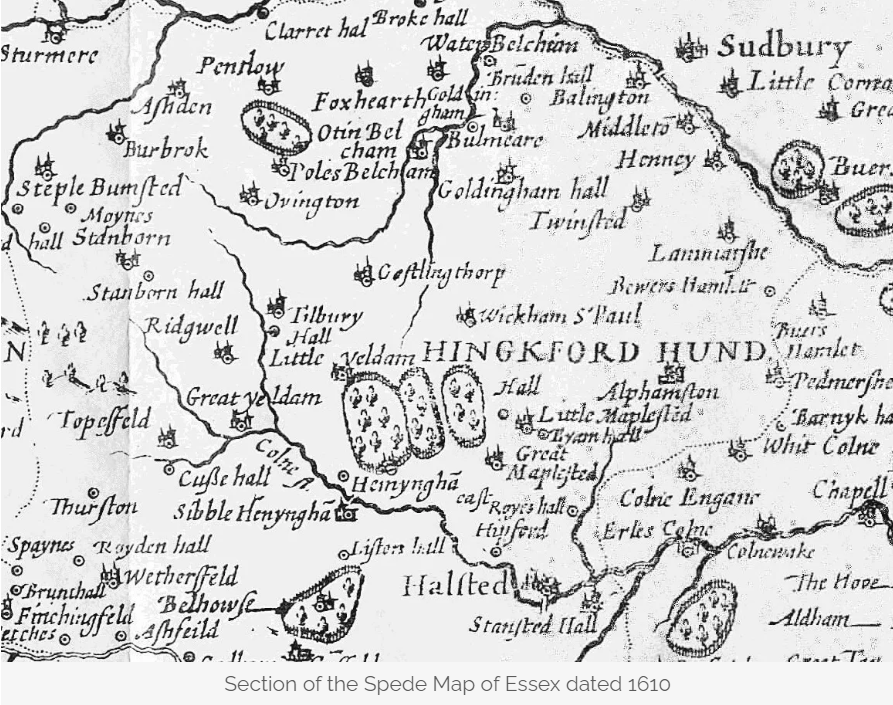
Poles Belchamp
The John Speed map of the Hundred of Hinckford show Poles Belcham at the location we now know as Belchamp St. Paul.
In the Domesday book Belchamp St Paul and Wickham St. Paul are described as possessions of the Canons of St. Paul, hence the name.
Top
The Tithe Award for Belchamp St. Paul
The St. Pauls:
"
Æthelstan, king of the English, confirmed 12 hides at Bylcham cum Wicham to St Pauls in 961 - 971. Bylcham was required to
provide one man for ship duty against invasions in c.995 - 998 (Hart, 1971; Kemble, 2007).
In Domesday Book, 1086, the canons of St Pauls held Belcham as a manor for 5 hides (Morris, 1883). Watts (2004) translates this from Old English bylc + ham, ‘homestead at the hill called Bylc’, or belc, ‘house with a roof of beams’. Early, the first element became confused with French belchamp, ‘beautiful field’ (Reaney, 1935).
The demesnes were 150 acres [of arable] and 14 acres of meadow, 120 acres of wood, in Lane Hele and Doreleche 15 acres.
During the Commonweath in 1649, Sir John Wollaston and others, trustees for the sale of St Paul’s lands, sold it to Thomas Cooke of Pebmarsh and others. St Paul’s recovered it after the Restoration (Morant, 1768).
The church dedicated to St Andrew was rebuilt by 1490; the west tower was restored in 1901.
Paul’s Hall is early 16th century, timber-framed with brick nogging. The barn dates from the 11th century, rebuilt c.1200.
Turners, in Church Street, is an aisled hall, dendro-dated to 1328/9 (Andrews, 1997; Pevsner, 2007).
The Hundred name is recorded in Domesday Book variously as Hidincfort, Hidincforda, Hinding(a)forda, -fort, Hiding(h)afort, Hidingh(e)-, Hidingeforda, and Hedingfort (Morris, 1983) which Reaney (1935) discusses as related to Hedingham, deriving from an Old English personal name Heðin, though it might be evidence of Old Scandinavian Heðinn. This raises the possiblity of evidence of Scandinavian influence in the north of the county, mainly attributed in Tendring Hundred (Kemble, 2007). Christy (1926) places the Hundred moot by the ford through the River Colne at Castle Hedingham where there was small mound.
"
Thomas Cooke of Pebmarsh
Belchamp St. Pauls' lands were presumably sold to Thomas Cooke. In a similar manner to Belchamp Walter, Belchamp St. Paul was in the possession of those supporting the Protectrate.
During the Commonweath in 1649, Sir John Wollaston and others, trustees for the sale of St Paul’s lands, sold it to Thomas Cooke of Pebmarsh and others. St Paul’s recovered it after the Restoration (Morant, 1768).
The recovery of the village by the Canons of St. Paul's would suggest that this sale was political, but not necessarily. The tenure of lands at Belchamp Walter have not been recorded that well over this period but it is known that Oliver Raymond was MP for Essex to two Protectrate parliaments.