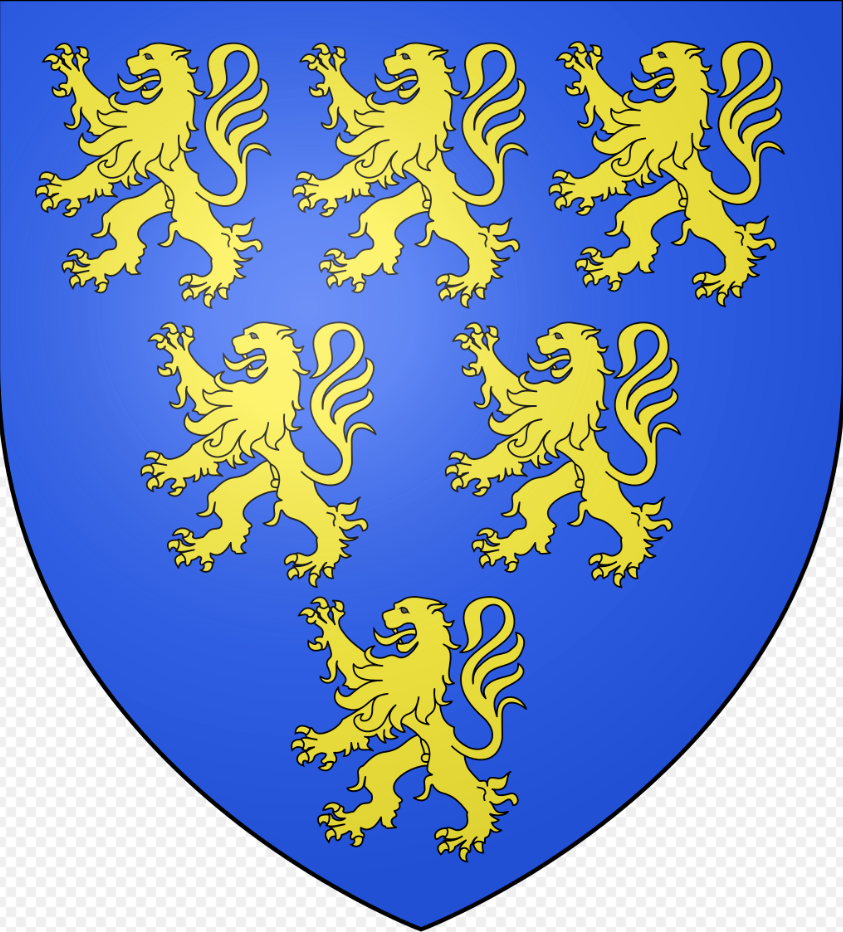
William Longespée, 3rd Earl of Salisbury
In or before 1167 – 7 March 1226 - the 12th and
13th Centuries
The connection of the Longespée family name to the history of Belchamp Walter comes via a marriage
to Ida Wake. Or possibly Ida Longespée, 2nd wife of
William de Beauchamp.
Wikipedia says:
"
William was an illegitimate son of Henry II, King of England.
His mother was unknown for many years until the discovery of a charter William made that mentions
"Comitissa Ida, mater mea" (Countess Ida, my mother).[2][3]
This referred to Ida de Tosny, a member of the prominent Tosny (or Toesny) family,
who had married Roger Bigod, 2nd Earl of Norfolk[4] in 1181.
The following is either Wikipedia or Thomas Wright:(probably Wikipedia)
"
Ida Longespée, married firstly Ralph who was son of Ralph de Somery, Baron of Dudley, and Margaret, daughter of John Marshal;[13] she married secondly William de Beauchamp, Baron of Bedford, by whom she had seven children.
This Ida is sometimes confused with Ida II Longespée, who married Sir Walter FitzRobert of Woodham Walter, Essex, by whom she had issue including Ela FitzWalter, wife of William de Odyngsells. Ida II Longespée has been given different parents by different genealogists; G. Andrews Moriarty suggested the two Idas were sisters; Gerald Paget suggests Ida II who married Walter FitzRobert may have been the daughter of William Longespée II, Earl of Salisbury, by his wife, Idoine de Camville.
"
Douglas Richardson has weighed in on this and there is a log thread on Google Groups where the
geneology of the two Idas is discussed.
Top
From the Wikipedia page on William de Beauchamp
Children of William de Beauchamp and Ida Longespee were: Maud de Beauchamp b abt 1234, d bef Apr 1273.
She md Roger de Mowbray abt 1247, son of William de Mowbray and Avice.
Ela de Beauchamp b abt 1240, Essex, England, d 1266.
She md Baldwin Wake abt 1254, son of Hugh Wake and Joan de Stuteville.
Beatrice de Beauchamp b abt 1245, prob Bedford, Bedfordshire, England, d 1280-1281.
She md Sir Thomas Fitz Otho bef 1264.
Their daughter, Maud/Matilda Fitz Thomas md Sir John de Botetourte abt 1284.
Ida de Tosny
Ralph de Tosny, Lord of Conches was a companion to William at Hastings.
According to Wikpedia:
Ida de Tosny, Countess of Norfolk (died after 1181), was a Norman royal mistress. Named after her grandmother
Ida de Hainaut, she was the daughter of Ralph IV de Tosny (died 1162) and his wife Margaret (born c. 1125
and living in 1185), a daughter of Robert de Beaumont, 2nd Earl of Leicester.[1]
Relationship to King Henry II
Ida de Tosny was a royal ward and mistress of Henry II, King of England, by whom she was mother of one of his
illegitimate sons, William Longespée, 3rd Earl of Salisbury,[2] (c. 1176 – 7 March 1226), as demonstrated by
the discovery of a charter of William
mentioning "Comitissa Ida, mater mea" (Countess Ida, my mother).[3] Ida was not the first English royal ward to be taken as a royal
mistress. Isabel de Beaumont (Elizabeth de Beaumont),
was the ward of King Henry I and the mistress of one of his sons.
Victoria History
Ida de Tosny - Possible mother of William Longespée, 3rd Earl of Salisbury
The following needs formatting - I think I have a copy of Victoria History for Essex.
THE LAND OF ROBERT DE TOESNI [TODENEIO] HUNDREd OF UDELESFORT [UTTLESFORD] CESEWIC [Cheswick (Hall) was held, in King Edward's time, by 1 free man as a manor and as ?? hides. Then as now (semper) 1 plough on the demesne, and 2 ploughs belonging to the men. Then and afterwards
4 villeins; now 3. (There are) now 2 bordars.
(There is) wood(land) for 100
swine, (and) 4 acres of meadow. It is worth
40 shillings.
fo. 91
LI. THE LAND OF RALF DE
TOESNI [TODENEIO]4
HUNDRET OF HERLAUA [HARLOW]
OUESHAM [Housham (Hall) 6
] is held of
R[alf] by Roger (as) half a hide which was
held by Etmar. Then as now (semper) i
plough. It was then worth 10 shillings ;
now 15.
LAGHEFARA [(Magdalen ?)
Laver 6
],
which was held by Sexi' 7 as a manor and as i hide, held of R[alf] by Roger. Then 4 villeins ;
now 3. (There are) now 7 bordars. Then
4 serfs ;
now 3.
Then 2 ploughs on the
demesne; now I. (There is) wood(land)
for 30 swine, (and) 16 acres of meadow.
Then as now (semper) 13 swine, and 60
sheep, and 4 cows. It is worth now as then
(semper) 70 shillings.
1
No reference to this holding can be detected
in the account of Peter de Valognes's fief.
3 The lord of the great Belvoir fief. His name
was derived from Toesni (Tosny) in Normandy.
A manor in Chreshall.
4 The head of his barony was at Flamstead,
Herts, and the origin of his name was the same
as Robert's.
6 A manor (formerly a hamlet) in Matching.
6 All the Lavers were in Ongar (not Harlow)
Hundred. Morant probably assigned this Hun
dred to Magdalen Laver because the other Laver
entries clearly refer to High and Little Laver.
This is a sound conclusion, but the manor is not
found, it would seem, in the hands of Ralf's heirs.
From Maurice Boddy
William commanded an expedition (1213) to help the Count of Flanders against the French.
The party of around 500 ships sailed to a Flanders port, described variously as Swine or Damme, where they found on 30th May the harbour full of French ships, from which the French troops had landed and were ravaging the country adjacent.
William took some 300 ships as prizes, laden with precious provisions and military stores, fired the remaining 100 or so, and returned to England. William, as Marshal of King John, commanded the combined forces which set sail again (June 1214).
They recovered almost all of Flanders for the Count of Flanders, but William and the Counts of Flanders and Boulogne were captured at the decisive Battle of Bouvines (27th July 1214), which annihilated King John's hopes, and forced him to beg a truce for 5 years.
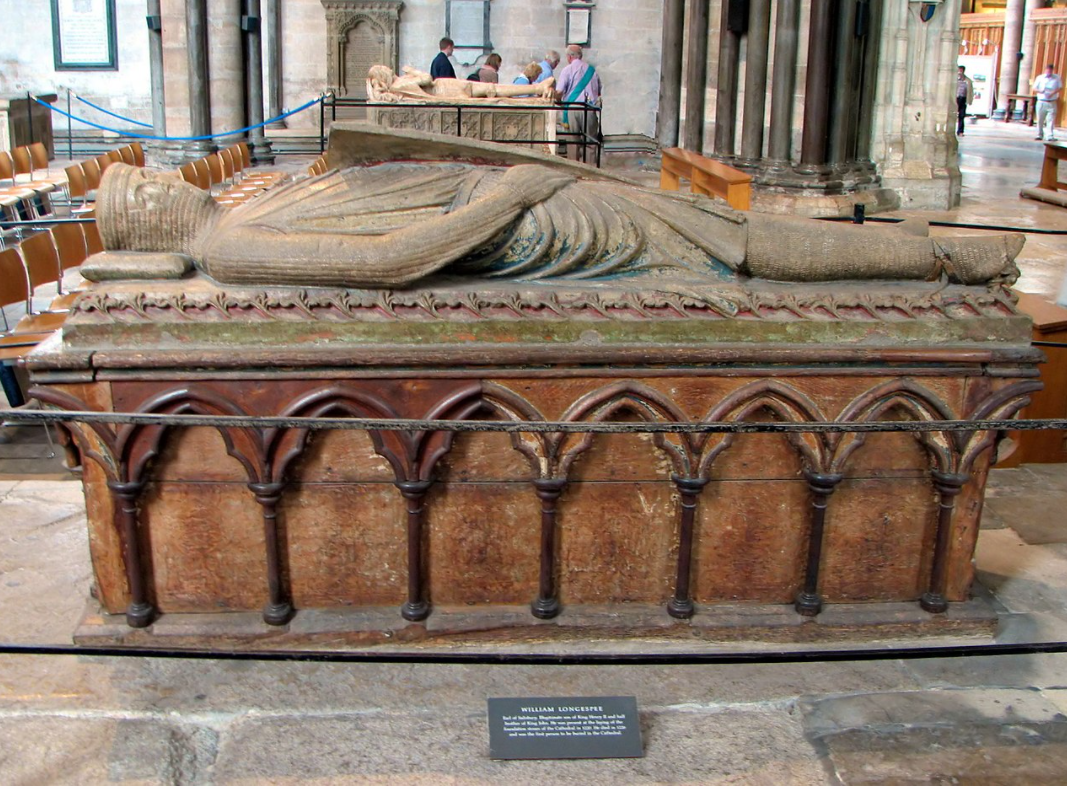
William died at Salisbury Castle (7th March 1225-26), poisoned by Hubert de Burgh, alleged the contemporary chronicler Roger of Wendover (he died in 1236). William was buried at the Cathedral there, where the modern plaque with his tomb reads: