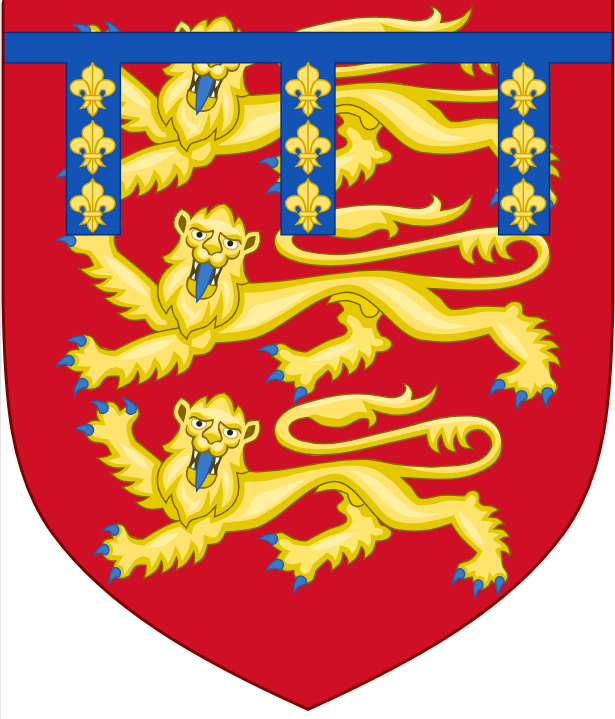
The earldom first created by Henry III for his son Edmund Crouchback
The houses of York and Lancaster are not really well explained, well at least to me.
The in-fighting between the monarchs after the creation of the House of Lancaster
John of Gaunt - 2nd House of Lancaster
The House of York
The House of York descended in the male line from Edmund of Langley, 1st Duke of York, the fourth surviving son of Edward III.
Edward IV, Edward V and Richard III were Yorkists
The House of York, Lancaster and primogeniture.
In time, it also represented Edward III's senior line, when an heir of York married the heiress-descendant of Lionel, Duke of Clarence, Edward III's second surviving son. It is based on these descents that they claimed the English crown. Compared with its rival, the House of Lancaster, it had a superior claim to the throne of England according to cognatic primogeniture, but an inferior claim according to agnatic primogeniture. The reign of this dynasty ended with the death of Richard III of England at the Battle of Bosworth Field in 1485. It became extinct in the male line with the death of Edward Plantagenet, 17th Earl of Warwick, in 1499.
The dispute between Edward II and Thomas Lancaster was is a precursor
House of Lancaster
My interest in the House of Lancaster relates Sir John de Botetourt fighting for Thomas Lancaster at the Battle of Borougbridge, 1322.
The House of Lancaster according to Wikipedia
The House of Lancaster was a cadet branch of the royal House of Plantagenet. The first house was created when King Henry III of England created the Earldom of Lancaster—from which the house was named for his second son Edmund Crouchback in 1267.
Edmund had already been created Earl of Leicester in 1265 and was granted the lands and privileges of Simon de Montfort, 6th Earl of Leicester, after de Montfort's death and attainder at the end of the Second Barons' War.[1]
When Edmund's son Thomas, 2nd Earl of Lancaster, inherited his father-in-law's estates and title of Earl of Lincoln he became at a stroke the most powerful nobleman in England, with lands throughout the kingdom and the ability to raise vast private armies to wield power at national and local levels.[2]
This brought him, and Henry, his younger brother, into conflict with their cousin King Edward II, leading to Thomas's execution.
Henry inherited Thomas's titles and he and his son, who was also called Henry, gave loyal service to Edward's son King Edward III.
Top
Thomas Lancaster according to Wikipedia
Thomas, 2nd Earl of Lancaster (c. 1278 – 22 March 1322) was an English nobleman of the first House of Lancaster
of the royal Plantagenet Dynasty. He was Earl of Lancaster, Leicester, and Derby from 1296 to 1322,
and Earl of Lincoln and Salisbury jure uxoris from 1311 to 1322. As one of the most powerful barons of England,
Thomas was one of the leaders of the baronial opposition to his first cousin, King Edward II.
Lancaster was one of the Lords Ordainers who demanded the banishment of Gaveston and the establishment of a
baronial oligarchy. His private army helped separate the king and Gaveston, and Lancaster was one of the "judges" who convicted Gaveston and saw him executed in 1312.
Shakespeare's history plays
There is an interesting comment in the Wikipedia page on the House of Lancaster with regard to the historical
accuracy of Shakespeare's history plays. This particular time in history and those that were connected to
the village of Belchamp Walter and surroundings area need to be seen in this light.
The involvement of Sir John de Boutetourt (first lord) with Edward I and Edward II, the role Sir John played in Edward I's activity in Scotland and later with the Lords Ordainers, Piers Gaveston and then Thomas Lancaster and the
battle of Boroughbridge are cases in point.