Artifacts found in Belchamp Walter church
The font, the memorials and of course the Wall Paintings
I have concerns about the text on the CSRBi website and I cannot see that they have referenced their information on the history of the village.
Thomas Wright is quoted as is Domesday. As I have said on other pages I have issues on both.
My fear that the Copford experience is going to be relived at Belchamp Walter - Daniel Bell, 1872
The Graffiti
I Suspect Thomas Organ viewed this page (March 2026) looking for more background on St. Mary's and Belchamp Walter - Wall Painting Inspection 2023 - I started this
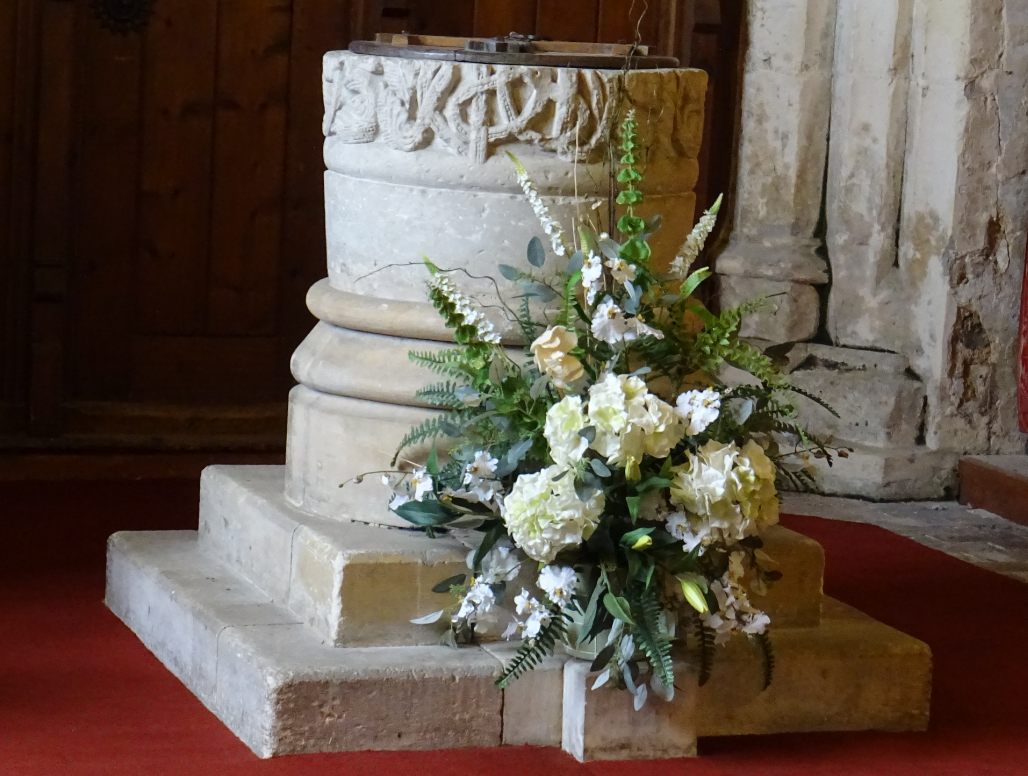
Norman Font at Belchamp Walter
The Norman (or earlier) font as seen in St. Mary the Virgin,
Belchamp Walter.
Having read the description from the EADT article (Belchamp Walter Romance) , date not known,
Top
Text from the EADT article:
"
The most striking link with the days of the Normans, however, is undoubtdly the font, for here is an
affair so uncommon and so remarkable in its rude dignity that it immeadiatly atracts the eye.
Massive and sturdy, born of an age which produced some remarkable decorative effects, the font is circular in shape and on its bowl are designs of various kinds rather crudely carved.
Apparently some sort of restoration has occurred here, but it is very ruggedness, almost a seggestion of the primitive, combined with the fact that the Eastern Counties are singularly lacking in fonts of a similar nature, this
striking relic is certainly outstanding.
"
The font is possibly one of the oldest artifacts in the Church. A lot of the earlier items were either removed, covered
up or destroyed in the Victorian "renovations".
The Corpus of Romanesque Sculpture in Britain and Ireland
Belchamp Walter is a village in the Braintree district of N Essex, 3 miles W of Sudbury and 3.5 miles S of the Suffolk border. The three Belchamp villages, of which this is the easternmost, occupy a network of minor roads in the rolling farmland on the S side of the River Stour. The village centre is at a crossroads, with the church and hall in a group 0.5 miles to the E. St Mary’s is a large church with a nave with a timber-framed S porch, a W tower and a chancel. Of these the chancel is the earliest, and may date from the 12thc to judge from the round-headed lancet in its N wall. At any event, the E wall has been replaced, a Y-tracery window installed, and the chancel lengthened c.1860. Around this time too, the chancel arch was rebuilt by John J Cole. The 14thc nave is much taller and wider than the chancel. The timber porch and the W tower are 15thc work. The nave contains well-preserved wall-paintings of the Passion and saints’ lives on the N wall, dating from the early 14thc, and the spectacular arched canopy of the 1324-25 tomb of Sir John de Boutetourt, which looks as if it had escaped from Westminster Abbey. The only Romanesque sculpture here is the font.
The three Belchamps: St Paul, Walter and Otten, are called simply Belcamp or Belcham in the Domesday Survey. The Canons of St Paul’s cathedral held a manor of 5 hides, presumably Belchamp St Paul, before and after the Conquest. A manor of 1 hide and 45 acres was held by Leodmaer in 1066 and by Ulmar from Count Eustace in 1086. A third manor of 2½ hides was held by Wulfwine in 1066 and by Aubrey de Vere in demesne in 1086, and finally a manor of 1 hide and 38 ½ acres was held by 6 free men in 1066, and by Robert de Vaux from Roger Bigod in 1086.
According to Wright (1831) Belchamp Walter was Aubrey de Vere’s holding, and passed through his daughter Roese to her son with her second husband, Payne de Beauchamp, Baron of Bedford. This was Simon de Beauchamp, steward of King Stephen, who was succeeded by his son William who died c.1260. For the later history of this manor the reader is referred to Wright (1831).

At the W end of the nave is the tub-shaped clunch bowl of a 12thc font set on a later base, plinth and step. The upper rim of the bowl has been shaved back, removing the upper part of a broad band of foliage carving in deep relief that encirles the top of the bowl. At the bottom of this band, approximately halfway up the bowl, is a low roll, and the lower part of the bowl is plain. It is unlined, and the shaving of the upper edge has removed any signs of lock fittings, but in compensation the newly exposed rim has been liberally decorated with graffiti. The foliage band is boldly carved, and is described here anticlockwise starting at the E.
At the E is a tangle of interlacing stems with nailhead ornament along them, terminating in bold, croos-hatched furled leaves at either end. At the ENE is a vertical fictive shaft decorated with barley-sugar twist. At the NE is the lower part of a roundel (the upper part lost through the saving of the rim), enclosing 2 pairs of furled leaves mirroring one another on the vertical and horizontal axes. At the N is a cross enclosed by a nebuly frame, with a palmette in each quadrant. At the NW are two more fictive shafts: the L with barley-sugar twist as before, and the R plain with drilled ornament on its base and capital. Running from the WNW to the WSW are 3 square leaves with nested ribs like chevron ornament, separated by plain shafts with drilled ornament like that at the NW. On the S side is a heavy double stem with deeply drilled ornament terminating at the SE in a big furled leaf with cross-hatched ornament.
The text on the CRSBi website on the history of the village is questionable and has little reference backup. The author does quote Thomas Wright (1836) but does not give the source.
The early history seems to be straight from a translation of Domesday and the fact that Aubrey de Vere was Tenent in Chief in 1086 is questioned by me and other historians. The Wulfwine in 1066 and before is also not known. The accession of the land to the de Beauchamps does not make sense in English. Again Wright is quoted but Thomas was possibly mis-quoting Morant's History of Essex.
The renovations to the chancel arch and the extension of the chancel are somewhat correct and I have other confirmations that Cole was the architect for the work.