The late 14th Century - Simon's head and Richard II
Edward III - reign 1327-1377 - Richard II Reign 1377-1399 - Hundred Years War 1337-1453.
The Peasants Revolt must have had some relevance to Belchamp Walter as some of the rebels gatheresd at Liston on their march to London.
January 2026 - Saw a few impressions and on review this page did not link well with other pages on this site. The connection to Liston and the reign of Richard II who suceeded Henry III
19 June 2026 - Came across Ashley Cooper's blog post on 1381 when looking to see why there have been many visits to the Roman Villa page. Seems that there is information that I can use to bolster my history pages.
I have a picture of Simon's head I could format this as two columns. Need to revisit David Michell as see what he says about Richard. Ashley does mention Richard and Simon but seems to concentrait on names that relate back to Gestingthorpe.
The quotes from Wikipedia are mainly to add links to other pages on this website. When the page is re-indexed hopefully there will be more impressions generated and possibly more clicking on other pages.
16 July 2026 - A visit to the Roman Villa page.
2 Oct 2026 - Saw Andrew Garfield on Graham Norton's Show,
The Uprising
Andrew Garfield's Role in The Peasants' Revolt
Andrew Garfield's portrayal of the Ploughman in "The Uprising" is a fictionalized account of the 1381 Peasants' Revolt in England. The film, directed by Paul Greengrass, dramatizes the uprising's main leaders, John Ball and Wat Tyler, played by Jamie Bell and Cosmo Jarvis, respectively. Garfield's character, Ploughman, is depicted as the leader of a band of outlaws inspired by the Peasants' Revolt, which sought to challenge the oppressive rule of King Richard II. The film's narrative explores the rebels' motivations, their actions, and the eventual outcome of their rebellion, which ultimately inspired the legend of Robin Hood.
The Peasant's Revolt - 1381
The region of Belchamp Walter, Liston, Gestingthorpe and Sudbury all featured in the events of The Peasants Revolt of 1381. The archbishop at the time was Simon of Sudbury who met his death on Tower Hill in 1381.
Simon Theobald, Bishop of London from 1361 to 1375 and Archbishop of Canterbury from 1375 until his death
on Tower Hill 1381. His body is buried in Canterbury, with a canon ball as his head, and his head was
sprited off to Sudbury where it remains today.
The proximity of the villages would have indicated that there would have been residents that were involved with the uprising. Some background information can be found on the 1381.online website - "The People of 1381".
Apart from the records of The People of 1381 Project not a lot is known about the history of the region in the late 14th century. The manor of Belchamp Walter was most likely held by the Botetourt family which is similarly undocumented for this period. Ecclesiastical records have Simon of Sudbury as Archbishop and Richard de Oakham or Richard Wright as vicar of Belchamp Walter.
The Great Plague of 1346 to 1353 was not long over in 1381 and England was at war with France (again!) in the Calroline period of The Hundred Years War - 1369–1389.
The coronation of Richard II also has another connection to the community of Liston as the coronation wafers were a "charter" the de Liston family. de Liston, who held it by the grand sergeancy of making, and placing before the king, five wafers on the day of his coronation.
Top
St Gregory's Church, Sudbury
Simon's head can be found in the vestry (in the tower) of t Gregory's Church, Sudbury.
While his body is buried in Canterbury, his head found its way back to his home town!

The son of Nigel Theobald, Simon of Sudbury (as he later became known) was born at Sudbury in Suffolk, studied at the University of Paris, and became one of the chaplains of Pope Innocent VI,[2] one of the Avignon popes, who in 1356 sent him on a mission to Edward III of England.
In 1361 Sudbury was made Chancellor of Salisbury[2] and in October that year the pope provided him to be Bishop of London, Sudbury's consecration occurring on 20 March 1362.[3] He was soon serving Edward III as an ambassador and in other ways. On 4 May 1375 he succeeded William Whittlesey as archbishop of Canterbury,[4] and during the rest of his life was a partisan of John of Gaunt.
In July 1377, following the death of Edward III in June, Simon of Sudbury crowned the new king, Richard II, at Westminster Abbey, and in 1378 John Wycliffe appeared before him at Lambeth, but Sudbury only undertook proceedings against him under great pressure.
In January 1380, Sudbury became Lord Chancellor of England,[5] and the insurgent peasants regarded him as one of the principal authors of their woes. Having released John Ball from his prison at Maidstone, the Kentish insurgents attacked and damaged the archbishop's property at Canterbury and Lambeth; then, rushing into the Tower of London, they seized the archbishop himself. So unpopular was Sudbury with the rebellious peasants that guards simply allowed the rebels through the gates,[citation needed] the reason being his role in introducing the third poll tax.
Wikipedia
The Wikipedia page for the Peasant's Revolt says:
The Peasants' Revolt, also named Wat Tyler's Rebellion or the Great Rising, was a major uprising across
large parts of England in 1381. The revolt had various causes, including the socio-economic and political
tensions generated by the Black Death in the 1340s, the high taxes resulting from the conflict with France
during the Hundred Years' War, and instability within the local
leadership of London.
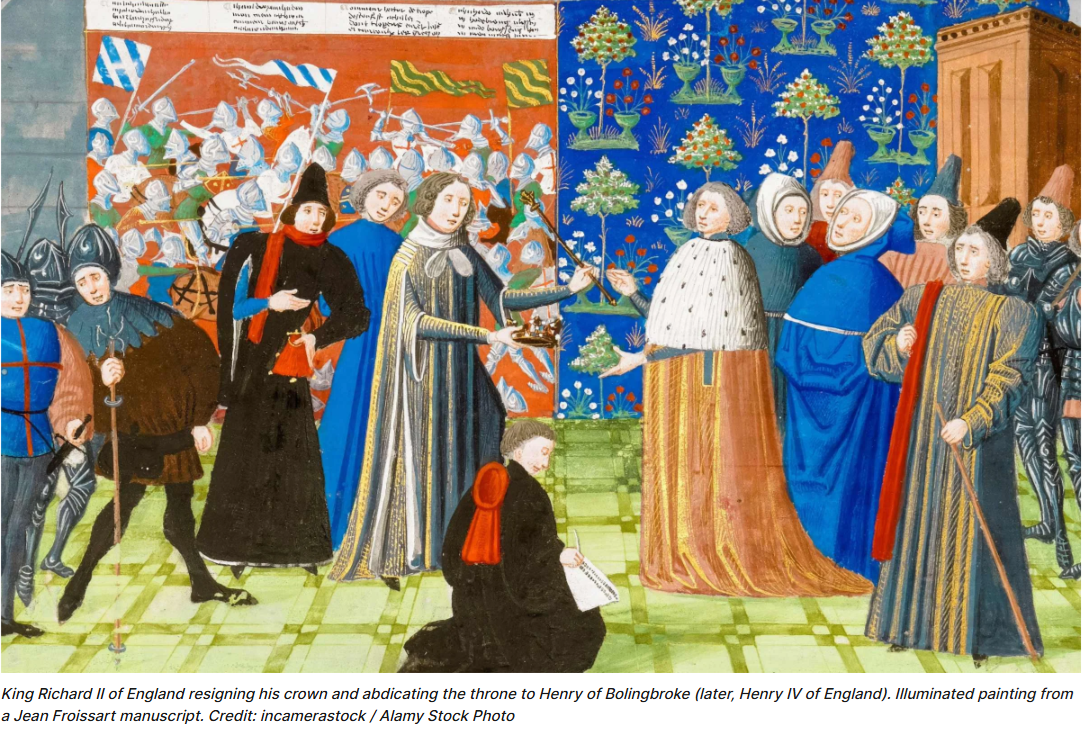
Richard II and his abdication
The relevance to Belchamp Walter, Liston and Gestingthorpe
Having established that there was a connection to Liston in that the peasants congregated at Liston before marching up to Long Melford and then down to Tower Hill, I find that there a couple of residents of Belchamp Walter that were involved with the uprising.
John Symond - Belchamp St. Paul
William Benyngton and others attack the property of Andrew Cavendyssh
Suffolk. Andrew Cavendyssh, knight, by his attorney versus William Benyngton, Robert Warnere of Gestingthorpe, Walter de Burton of Helions Bumpstead, Henry son of Walter de Burton, John Pappe of Helions Bumpstead, John Bride of Helions Bumpstead, John Mors of Helions Bumpstead, Simon Cook of Hempstead, William Colman of Finchingfield, Walter Cartere of Finchingfield, John Sexteyn of Stambourne, John Fynch of Stambourne, John Fraunceys of Helions Bumpstead, Richard Hempstede of Helions Bumpstead, John Coupere of Helions Bumpstead, Richard Webbestere of Finchingfield, John Moor of Hempstead, Stephen Northay of Wethersfield, junior, William son of Roger Selonge of Wethersfield, Thomas Roberd of Hempstead, Robert the parish priest of Hempstead, William Swete of Hempstead and John Symond of [Otton/St Paul's/Walter] Belchamp, on a plea that with force and arms they broke the close and houses of the said Andrew at Bury St Edmunds, and cut down his new trees, and took and carried away other goods and chattels worth £100, and also a certain chest containing six wallets of charters, writings and other muniments, and other injuries, to great harm and against the peace.
William Mellere ( 15332 ) - Belchamp Walter
The 15332 is a reference from the 1381.online database. The record for William Mellere has the description of his pardon.
William Askeby - Gestingthorpe
John Mot - Gestingthorpe